
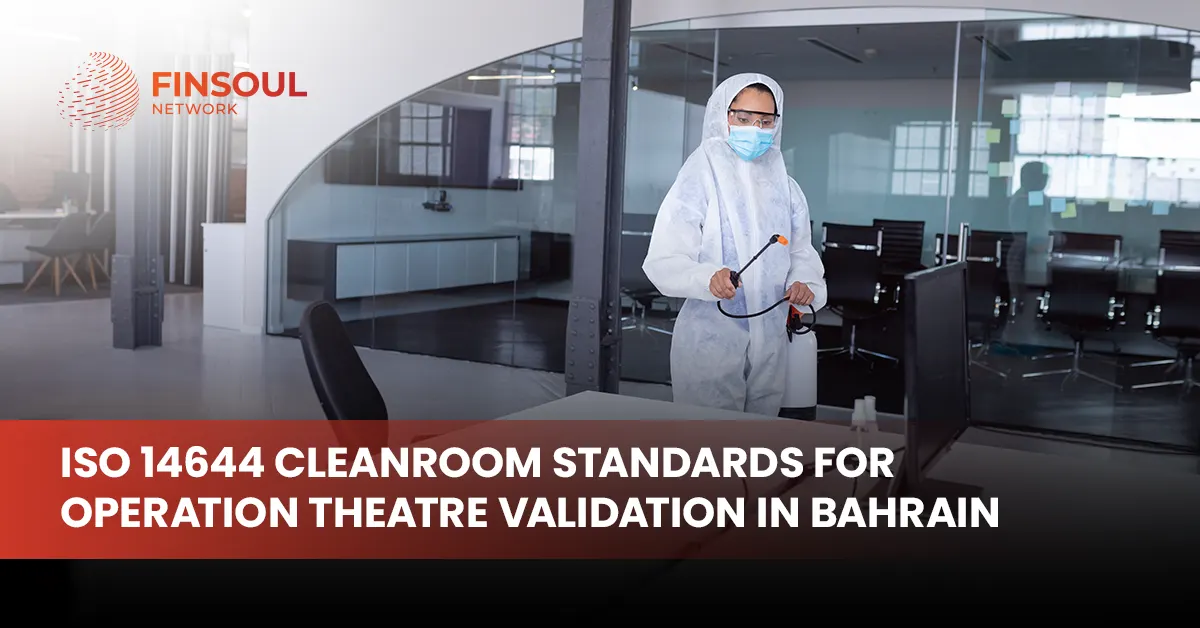
Hospitals and day-surgery centers across the Kingdom are under growing pressure to prove that their operation theatres are genuinely sterile, controlled environments, not just on paper, but under real testing conditions. That’s exactly what ISO 14644 cleanroom standards in Bahrain are designed to verify. At Finsoul Network Bahrain, we work with healthcare facilities to turn this technical standard into a practical, auditable compliance process, rather than a confusing checklist nobody fully understands.
Beyond meeting regulatory expectations, proper cleanroom validation helps minimise contamination risks, protect patient safety, and improve the reliability of surgical procedures. Regular testing and documented compliance also strengthen accreditation efforts, reduce operational risks, and demonstrate a facility’s commitment to maintaining the highest standards of healthcare quality.
This guide breaks down what ISO 14644 actually requires, how operation theatre validation works locally, what it costs, and how to keep your facility compliant year-round.
What Is ISO 14644 and Why It Matters for Bahrain’s Hospitals
ISO 14644 is an international family of standards that defines how cleanrooms and controlled environments, including hospital operation theatres, should be classified, tested, and monitored. It covers particle concentration limits, airflow behavior, pressure differentials, and the testing methods used to confirm all of it. For any facility pursuing ISO 14644 cleanroom standards in Bahrain, this isn’t a one-time paperwork exercise; it’s an ongoing engineering and monitoring commitment tied directly to patient safety and infection control.
Bahrain’s healthcare sector, both public and private, increasingly references this standard when licensing new surgical facilities or renewing operating permits, which is why understanding it properly matters more each year.
Understanding ISO Certification Bahrain Requirements for Hospitals
Getting ISO certification Bahrain authorities and accreditation bodies will recognize involves more than installing a good HVAC system. Facilities need documented evidence of design qualification, installation qualification, operational qualification, and performance qualification, each mapped back to ISO 14644 clauses. Auditors typically expect calibration records, airflow visualization studies, and a clear maintenance schedule alongside the classification report itself.
Many hospitals underestimate this stage and treat certification as a formality, only to fail their first audit because supporting documentation wasn’t structured correctly from day one.
Cleanroom Classifications Under ISO 14644 Bahrain Standards
Under ISO 14644 Bahrain facilities typically classify operation theatres somewhere between Class 5 and Class 8, depending on the type of surgery performed. Orthopedic and implant surgeries generally demand a stricter classification than general surgical suites, because airborne particle tolerance is far lower where open wounds or implants are involved.
Classification isn’t a label you choose; it’s the result of actual particle counting under “at-rest” and “operational” conditions, tested with calibrated particle counters at specified sampling points across the room.
Key Parameters Tested During Operation Theatre Validation Bahrain
Operation theatre validation Bahrain projects generally test five core parameters:
- Airborne particle count: measured at rest and during simulated activity
- Air change rate per hour (ACH): confirming sufficient dilution and removal of contaminants
- Room pressure differential: ensuring air flows from clean to less-clean zones, not the reverse
- Temperature and humidity: within ranges that limit microbial growth
- Recovery time: how quickly the room returns to its classified state after a disturbance
Each of these ties directly back to ISO 14644’s technical clauses, and a facility can fail validation on just one parameter even if everything else passes.
Step-by-Step Cleanroom Validation Bahrain Process
A typical cleanroom testing Bahrain engagement follows this sequence:
- Design review: checking HVAC layout, filter placement, and room geometry against ISO 14644 principles
- Installation checks: confirming HEPA filters, ductwork, and pressure zones are built as specified
- Baseline testing: particle counts, airflow velocity, and pressure readings taken at rest
- Operational testing: the same measurements repeated under simulated working conditions
- Documentation and certification: compiling results into a formal validation report with classification stated clearly
Facilities that skip the design review step often discover expensive structural issues only after installation, which is why early involvement of a validation partner saves both time and budget.
Regulatory Bodies Overseeing ISO 14644 Cleanroom Standards in Bahrain
Compliance expectations for ISO 14644 cleanroom standards in Bahrain are shaped largely by the National Health Regulatory Authority (NHRA) and the Ministry of Health, both of which reference international cleanroom benchmarks when licensing surgical facilities. While Bahrain doesn’t operate a separate national cleanroom standard, ISO 14644 is the reference framework most commonly cited in facility audits, tender documents, and hospital accreditation reviews.
This makes it essential for facility managers to work with validation providers who understand both the technical standard and how local regulators interpret it in practice.
Common Compliance Gaps in Bahrain Operation Theatres
Across audits, a handful of issues repeat themselves: HEPA filters installed but never leak-tested, pressure differentials that drift out of range within months of certification, and monitoring logs that stop being maintained once the initial certificate is issued. None of these are dramatic failures on their own, but together they’re the most common reason facilities lose accreditation on renewal.
Ongoing monitoring, not just the initial test, is what keeps a theatre genuinely compliant rather than compliant on paper for one day a year.
Cost Factors for ISO 14644 Cleanroom Standards Compliance in Bahrain
Pricing for ISO 14644 cleanroom standards in Bahrain compliance varies based on theatre size, existing HVAC condition, and classification target. Rough cost drivers include:
- Number of operation theatres being tested
- Target classification (Class 5 testing costs more than Class 8)
- Whether it’s initial validation or periodic re-qualification
- Remedial work needed after baseline testing (filter replacement, ductwork sealing, etc.)
Facilities pursuing certification for the first time should budget for both the testing itself and a contingency for corrective work, since it’s rare for a facility to pass every parameter on the first attempt.
Choosing the Right Partner for ISO Certification Bahrain
Not every testing provider offering ISO certification services in Bahrain has the calibration equipment or documentation experience hospitals actually need. Look for partners who provide traceable calibration certificates, clear reporting against specific ISO 14644 clauses, and support beyond the one-time test, including guidance on what to fix if a parameter fails.
Maintenance and Ongoing Monitoring After Cleanroom Validation Bahrain
Passing initial cleanroom validation Bahrain testing is the starting point, not the finish line. HEPA filters need periodic integrity testing, pressure sensors need recalibration, and particle counts should be spot-checked between full re-validation cycles, typically annually, though high-risk theatres may need more frequent checks. Facilities that build this into routine facility management avoid the scramble of last-minute remedial work before a renewal audit.
Professional ISO 14644 Cleanroom Validation Services in Bahrain
Finsoul Network Bahrain assists hospitals, clinics, and healthcare facilities in meeting ISO 14644 cleanroom standards through comprehensive operation theatre validation, cleanroom testing, documentation, and compliance support. From particle count testing and airflow verification to pressure differential monitoring and re-validation, our experienced team helps ensure your controlled environments meet regulatory and accreditation requirements with confidence.
Office Address: Office 41, Building 2737, Road 3649, Seef, Al Manama 436, Bahrain
Email: info@finsoulnetwork.com
Phone: +973 3383 2422
Conclusion
Meeting ISO 14644 cleanroom standards in Bahrain isn’t just about passing one audit; it’s about building an operating theatre environment that consistently protects patients, procedure after procedure. From classification and validation testing to ongoing monitoring, every step matters more than the certificate itself. Finsoul Network Bahrain works alongside hospitals and clinics to make that process straightforward, well-documented, and built to hold up at renewal time, not just on day one.
A proactive approach to cleanroom compliance also helps healthcare facilities maintain operational efficiency, reduce the likelihood of non-conformities, and inspire confidence among patients, staff, and regulatory authorities. By implementing regular testing, preventive maintenance, and comprehensive documentation, hospitals can ensure their operation theatres continue to meet the highest standards of cleanliness, safety, and performance throughout the year.
Frequently Asked Questions
How often does an operation theatre need re-validation under ISO 14644?
Most facilities re-validate annually, though theatres used for high-risk procedures may require testing every six months depending on their classification.
Is ISO 14644 legally mandatory for hospitals in Bahrain?
It isn’t a standalone national law, but regulators and accreditation bodies commonly reference ISO 14644 during licensing and facility audits.
What’s the difference between cleanroom validation and cleanroom certification?
Validation is the testing process itself, while certification is the formal document issued once the cleanroom meets its target ISO classification.
Can an existing operation theatre be upgraded to meet ISO 14644 without full reconstruction?
Often, yes. Many compliance gaps can be addressed through HVAC adjustments, HEPA filter upgrades, improved sealing, and airflow optimisation rather than a complete rebuild.
How long does a typical validation process take?
For a single operation theatre, testing and reporting usually take a few days. However, if remedial work and re-testing are required, the overall timeline may be extended.