
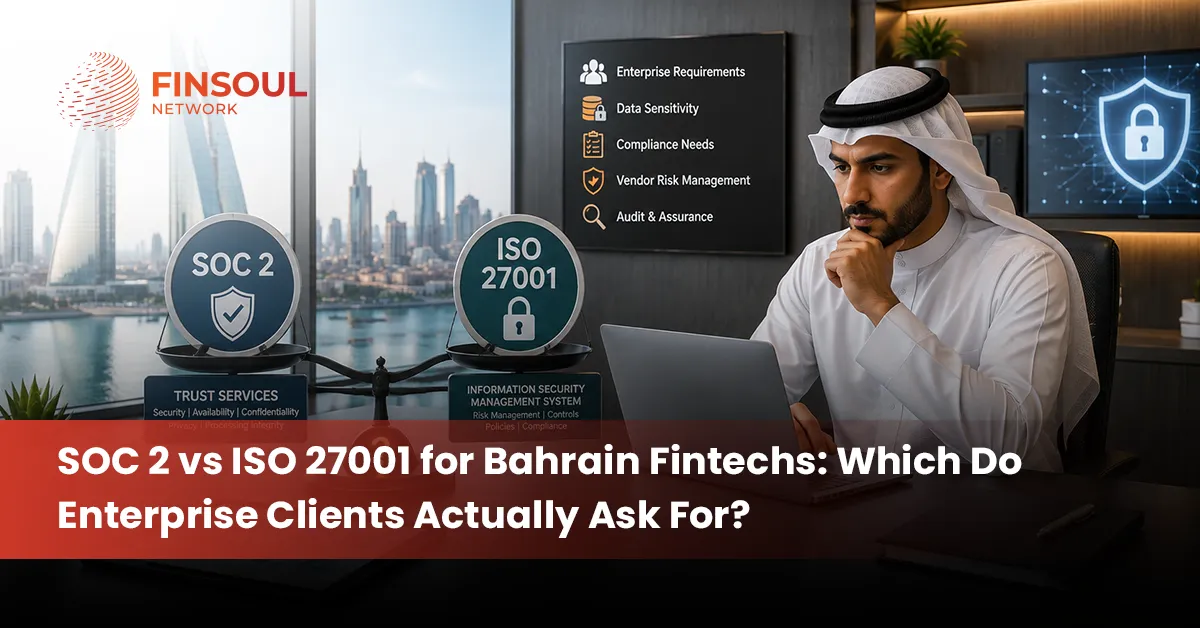
For a Bahrain fintech selling technology to banks, financial institutions or large enterprises, strong cybersecurity controls are only part of the challenge. Enterprise buyers increasingly want independent evidence that those controls exist and operate as expected.
This is where SOC 2 compliance Bahrain and ISO 27001 certification Bahrain become relevant. The two are often presented as competing security credentials, but they provide different forms of assurance. ISO/IEC 27001 is an international standard used to certify an Information Security Management System (ISMS), while SOC 2 is an attestation examination that reports on controls relevant to security and other selected Trust Services Criteria.
For fintechs in 2026, the better question is not simply whether SOC 2 or ISO 27001 is stronger. It is which assurance format the enterprise clients you want to win actually expect.
SOC 2 vs ISO 27001: What Is the Main Difference?
ISO 27001 certifies an organisation’s information security management system, while SOC 2 provides an independent attestation report about controls within a defined service organisation and system.
ISO/IEC 27001:2022 remains the current requirements standard for an ISMS, alongside Amendment 1:2024. It takes a risk-based approach to information security and requires organisations to establish, maintain and continually improve a structured management system.
SOC 2 is based on the American Institute of Certified Public Accountants’ Trust Services Criteria. A SOC 2 examination always addresses security and may also include availability, processing integrity, confidentiality or privacy depending on the scope.
| Area | SOC 2 | ISO 27001 |
| Assurance type | Attestation report | Management-system certification |
| Framework owner | AICPA | ISO and IEC |
| Main focus | Controls relevant to a defined system/service | Information Security Management System |
| Output | SOC 2 report | ISO/IEC 27001 certificate |
| Geographic recognition | Particularly common in US enterprise and SaaS procurement | Broad international recognition |
| Operating effectiveness | Type II examines controls over a period | Assessed through certification and surveillance |
| Detailed client report | Yes, for authorised users | Certificate itself provides less control-testing detail |
| Best fit | Detailed customer/vendor assurance | Organisation-wide security governance |
The distinction matters because an enterprise procurement team may accept one credential for one purpose while specifically requesting the other for another.
What Does SOC 2 Compliance Mean for a Bahrain Fintech?
SOC 2 compliance Bahrain refers to a fintech having relevant controls independently examined against applicable AICPA Trust Services Criteria.
Security is central to a SOC 2 examination. Additional criteria can be included according to the service and customer requirements.
These may address:
- Availability: Whether systems are available for operation and use as committed
- Processing integrity: Whether system processing is complete, valid, accurate, timely and authorised
- Confidentiality: Whether information designated as confidential is appropriately protected
- Privacy: Whether personal information is managed according to applicable privacy criteria
This model can be particularly relevant to fintechs offering SaaS platforms, APIs, payment technology, transaction processing or other services where an enterprise customer depends directly on the provider’s systems and controls.
SOC 2 Type I vs Type II
A Type I report evaluates the design of controls at a specified point in time. It can show that an organisation has established an appropriate control environment.
A Type II report goes further by examining whether relevant controls operated effectively over a defined period.
For enterprise vendor-risk teams, Type II can therefore carry greater practical value. The buyer receives evidence not only that controls were designed, but that their operation was independently tested across the reporting period.
SOC 2 Certification Is Not Technically a Certification
The keyword SOC 2 certification Bahrain is commonly searched, but the terminology is technically incorrect.
Organisations do not receive a SOC 2 certificate in the same way that they receive ISO 27001 certification. A qualified CPA practitioner performs the SOC 2 examination and issues an attestation report.
This distinction becomes important when dealing with sophisticated financial institutions. A procurement team asking for a “SOC 2” may actually expect a current SOC 2 Type II report, including a defined system scope and reporting period.
A Bahrain fintech should therefore clarify exactly what evidence a potential client requires rather than treating every request for “SOC 2 certification” as identical.
What Does ISO 27001 Certification Mean for Bahrain Fintechs?
ISO 27001 certification demonstrates that an organisation has established an Information Security Management System conforming to ISO/IEC 27001 requirements within the certified scope.
ISO/IEC 27001:2022 uses a risk-based management approach. Rather than prescribing the same security configuration for every organisation, it requires the business to understand its information-security risks, determine appropriate treatment and maintain evidence that the ISMS operates and improves.
This includes areas such as:
- Information-security risk assessment and treatment
- Leadership and security responsibilities
- Security policies and objectives
- Access and identity management
- Supplier and third-party security
- Incident management
- Business continuity considerations
- Monitoring and performance evaluation
- Internal audit and management review
- Corrective action and continual improvement
For Bahrain fintechs planning to operate across multiple GCC or international markets, this internationally standardised management-system approach can provide a portable security foundation.
Which Do Enterprise Clients Actually Ask For?
There is no universal rule that Bahrain enterprise clients require ISO 27001 while international clients require SOC 2. Procurement requirements depend on the buyer, jurisdiction, service risk, data involved and internal third-party-risk programme.
However, the commercial patterns are different enough to guide a fintech’s assurance strategy.
| Client or sales situation | Assurance likely to be useful |
| Bahrain or GCC enterprise | ISO 27001 commonly provides recognisable international assurance |
| Regional bank or financial institution | ISO 27001 plus evidence against applicable regulatory requirements |
| US enterprise customer | SOC 2 Type II may be specifically requested |
| International SaaS procurement | SOC 2 can be particularly valuable |
| Multinational enterprise | ISO 27001, SOC 2 or both depending on procurement policy |
| High-risk technology supplier | Both may form part of a wider assurance package |
| CBB-regulated activity | Applicable CBB requirements must be addressed separately |
The table should not be read as a regulatory requirement. It is a decision framework for understanding why different enterprise buyers can request different evidence.
Why ISO 27001 Often Makes Sense for Bahrain and GCC Clients
ISO 27001 has broad international recognition and is not tied to one country’s enterprise assurance ecosystem. That makes it useful when a Bahrain fintech expects customers across the Gulf, Europe, Asia or multiple jurisdictions.
A certificate also provides procurement teams with a recognisable indication that an independent certification process has assessed the organisation’s ISMS within a defined scope.
For a fintech building its security governance from the ground up, ISO 27001 can also provide a useful operating structure. Security risk assessment, internal audit, management review, objectives and continual improvement become part of one management system rather than separate customer-compliance exercises.
This is particularly relevant when the company expects its technology, workforce, suppliers and geographic footprint to expand.
Why International SaaS Clients May Ask for SOC 2 Type II
SOC 2 is especially established within the US technology and service-organisation assurance environment.
An enterprise customer outsourcing an important function to a fintech may need more than confirmation that a security management system has been certified. Its vendor-risk team may want detailed independent information about the specific controls operating within the service it intends to use.
A SOC 2 Type II report can provide that additional depth by describing the system and reporting on control testing across a period.
This explains why an organisation can already hold ISO 27001 certification and still receive a request such as:
“Please provide your latest SOC 2 Type II report.”
The buyer is not necessarily rejecting ISO 27001. Its internal vendor-assurance process may simply require a different form of evidence.
How Does the CBB Change the SOC 2 vs ISO 27001 Decision?
For regulated Bahrain fintechs, enterprise assurance and regulatory compliance must be treated as separate but connected requirements.
The Central Bank of Bahrain maintains cybersecurity requirements for relevant regulated entities. Depending on the applicable CBB Rulebook volume and licence category, these can cover cybersecurity governance, risk management, board oversight, incident management, third-party risk and other security controls.
Importantly, CBB cybersecurity requirements in relevant rulebooks reference the NIST Cybersecurity Framework. This means a fintech should not assume that obtaining ISO 27001 certification or completing SOC 2 automatically demonstrates compliance with every applicable CBB requirement.
The correct approach is to identify applicable regulatory obligations first and then map the organisation’s control environment against them.
A fintech can therefore have three different assurance layers:
CBB requirements → regulatory compliance
ISO 27001 → internationally certified ISMS
SOC 2 → detailed service-organisation control assurance
They overlap, but they are not interchangeable.
Why Enterprise Banks Care About Third-Party Assurance
The question becomes particularly important when a fintech provides technology to a bank rather than operating only as a consumer-facing application.
Banks need to understand the risk introduced by critical technology providers, cloud services and outsourced systems. CBB cloud-outsourcing guidance for relevant banking licensees addresses areas including information security, business continuity, data sensitivity, legal and compliance risk, subcontracting and concentration risk.
That changes the procurement conversation.
A bank evaluating a fintech may examine:
- Information-security governance
- Independent security assurance
- Cloud architecture and hosting
- Data location and protection
- Access and privileged-account management
- Incident-response arrangements
- Business continuity and disaster recovery
- Penetration testing and vulnerability management
- Subprocessors and other third parties
- Regulatory and contractual obligations
An ISO 27001 certificate or SOC 2 report can support this review, but neither removes the bank’s responsibility to perform its own risk-based due diligence.
SOC 2 Gives Enterprise Clients Something ISO 27001 Does Not
One of SOC 2’s strongest advantages is the level of assurance information available in the report.
An ISO 27001 certificate can confirm that the ISMS within the stated scope has been independently certified. It does not provide an enterprise customer with the same detailed report on specific controls and testing that a SOC 2 Type II engagement can provide.
For a security or vendor-risk team trying to evaluate a critical SaaS provider, this detail can be important.
It may allow the customer to understand which controls were tested, the period covered and the results of that testing rather than relying only on a certificate and security questionnaire.
ISO 27001 Gives the Fintech Something SOC 2 Does Not
ISO 27001’s major strength is its management-system architecture.
The fintech has to establish a repeatable process for understanding information-security risks, selecting appropriate treatment, assigning responsibilities, monitoring performance and continually improving the system.
This becomes increasingly valuable as a fintech grows.
New APIs, employees, cloud services, products, vendors and markets continually change the organisation’s risk profile. An ISMS provides a governance structure through which those changes can be assessed instead of allowing security to become a collection of disconnected technical controls.
Can a Bahrain Fintech Use the Same Controls for Both?
Yes. Significant control overlap means a mature fintech should avoid building completely separate ISO 27001 and SOC 2 programmes.
Areas that can support both commonly include access management, security monitoring, change management, vulnerability management, incident response, business continuity, supplier management, risk assessment and employee security.
The more efficient architecture is:
One control environment → multiple assurance mappings
For example:
CBB requirements → ISO 27001 → SOC 2 → individual enterprise requirements
The underlying control may remain the same while evidence and mapping differ according to the framework.
However, overlap does not create equivalence. An ISO 27001 certificate does not automatically produce a SOC 2 report, and a SOC 2 Type II report does not mean the organisation has an ISO 27001-certified ISMS.
If You Can Only Choose One First, Which Should It Be?
The first framework should follow the fintech’s actual customer pipeline and regulatory environment, not whichever security badge appears most frequently on competitor websites.
Start With ISO 27001 When
- Bahrain and GCC enterprises are the main target customers
- Regional expansion is part of the business strategy
- The organisation needs a structured ISMS
- Internationally recognised certification appears in tenders or onboarding
- Customers operate across several jurisdictions
Prioritise SOC 2 When
- US enterprise customers are already requesting a SOC 2 report
- The fintech primarily provides SaaS, APIs or technology infrastructure
- Vendor-risk teams require detailed independent control-testing evidence
- A significant enterprise contract depends on SOC 2 Type II
- North American expansion is a major commercial priority
For some mature fintechs, the eventual answer will be both. The important decision is which one removes the most immediate regulatory, governance or sales barrier.
The Scope Matters More Than the Security Logo
Enterprise clients do not buy a certification logo. They need assurance about the systems and services they will actually depend on.
If a fintech’s ISO 27001 certificate covers only corporate IT but excludes the platform being offered to the customer, its value for that procurement exercise may be limited.
The same issue applies to SOC 2 Bahrain. The system described in the SOC 2 report needs to correspond meaningfully to the service being assessed by the enterprise client.
Fintechs should therefore examine:
What legal entity is covered? What product is covered? Which systems are included? Which locations are included? What reporting period applies?
These details can matter more to an experienced vendor-risk team than the presence of another compliance logo on the fintech’s website.
What Should a Bahrain Fintech Have Ready for Enterprise Due Diligence?
ISO 27001 and SOC 2 should sit inside a broader enterprise assurance package.
| Evidence | Why enterprise clients may request it |
| ISO 27001 certificate | Verify certified ISMS and scope |
| SOC 2 report | Review independent service-control assurance |
| Penetration-test evidence | Understand technical security testing |
| Incident-response plan | Assess readiness for security events |
| Business continuity and DR | Evaluate operational resilience |
| Vendor-risk controls | Understand third-party dependencies |
| Cloud-security information | Assess hosting and infrastructure risk |
| Privacy documentation | Review personal-data handling |
| Vulnerability management | Understand remediation processes |
| Regulatory mapping | Assess relevant CBB or other obligations |
A fintech that prepares this evidence before procurement begins can respond more efficiently when enterprise security questionnaires arrive.
Which Assurance Should Bahrain Fintechs Prioritise in 2026?
For a Bahrain fintech whose commercial focus is primarily Bahrain and GCC enterprise clients, ISO 27001 is generally the more logical first assurance framework because it provides internationally recognised ISMS certification and can support regional security governance.
For a fintech selling heavily into US enterprise SaaS and technology procurement, SOC 2 Type II can become commercially more important because customers may explicitly request the report as part of third-party-risk assessment.
Where the customer base spans both environments, the long-term strategy may be to maintain ISO 27001 as the security-management foundation and use the same mature control environment to support SOC 2 assurance.
The decision should therefore come from actual customer requirements, not assumptions about which framework sounds more advanced.
Build Security Assurance Around the Clients You Need to Win
The real SOC 2 compliance Bahrain question is not whether SOC 2 is better than ISO 27001. It is whether the assurance evidence matches the risks and expectations of the fintech’s most important customers.
ISO 27001 provides a globally recognised management-system certification. SOC 2 Type II provides detailed independent assurance about defined service controls operating over a period. CBB cybersecurity requirements create a separate regulatory layer that must be assessed directly rather than assumed to be covered by either framework.
ISO Consultancy Bahrain continues to track developments in information-security standards and Bahrain’s cybersecurity environment as fintechs face increasingly detailed enterprise assurance requirements. For fintech management teams, the strongest strategy is to build one defensible security-control environment and then map it to the regulatory and customer assurance requirements that actually affect the business.
FAQs
Is SOC 2 Mandatory for Fintech Companies in Bahrain?
No. There is no general requirement making SOC 2 mandatory for every Bahrain fintech. Applicable CBB requirements depend on the organisation’s licence and activities, while SOC 2 may arise as a commercial requirement from enterprise customers. A fintech selling technology to international businesses may therefore encounter SOC 2 requirements during procurement even where it is not a statutory certification requirement.
Is ISO 27001 Mandatory for Bahrain Fintechs?
ISO 27001 is not a universal mandatory certification for every Bahrain fintech. Regulated firms must identify and comply with the cybersecurity requirements applicable to their CBB licence and activities. ISO 27001 can independently demonstrate a structured ISMS, but certification should not be presented as automatically satisfying all CBB cybersecurity obligations.
Is SOC 2 Certification Bahrain the Same as ISO 27001 Certification Bahrain?
No. Although SOC 2 certification Bahrain is a common search phrase, SOC 2 technically results in an attestation report rather than certification. ISO 27001 is a certifiable international management-system standard. The assessment approach, output and way enterprise customers use the resulting assurance are therefore different.
Is SOC 2 Type II Better Than ISO 27001 for Enterprise Clients?
Neither is universally better. SOC 2 Type II can be more useful where a customer wants detailed independent evidence that defined controls operated effectively over a reporting period. ISO 27001 can be more useful where customers want internationally recognised certification of a structured Information Security Management System. Some high-risk enterprise customers may value or request both.
Should a Bahrain Fintech Get ISO 27001 or SOC 2 First?
A Bahrain or GCC-focused fintech may reasonably prioritise ISO 27001 first, particularly when it needs a formal ISMS and internationally recognised certification. A fintech targeting US enterprise SaaS customers may need SOC 2 Type II earlier if prospects explicitly request it. The best sequence should follow applicable CBB obligations, target markets and actual enterprise procurement requirements rather than a fixed industry rule.