
Bahrain imports most of the food it consumes, which makes food safety as much about supply chain control as kitchen hygiene. For manufacturers, exporters, and larger food service operators, HACCP certification in Bahrain has become the credential that retailers, government buyers, and overseas customers increasingly expect before signing a contract. At Finsoul Network Bahrain, we see this come up constantly with food businesses trying to win new accounts, so this guide walks through what HACCP requires, how it differs from baseline food licensing, and how the certification process plays out from start to finish.
HACCP Actually Covers
HACCP, short for Hazard Analysis and Critical Control Points, is built around seven principles rather than a single checklist. A business pursuing certification needs to demonstrate all seven in practice, not just on paper.
- Conduct a hazard analysis to identify biological, chemical, and physical risks at each stage of food handling.
- Determine critical control points (CCPs), the exact stages where a hazard can be prevented, eliminated, or reduced to a safe level.
- Establish critical limits for each CCP, such as a minimum cooking temperature or a maximum storage time.
- Set up monitoring procedures that check whether each CCP stays within its critical limit during actual operations.
- Define corrective actions for what happens the moment a limit is breached, before the issue reaches a customer.
- Build verification procedures to confirm the whole system is working as intended, not just assumed to be working.
- Maintain records and documentation detailed enough that an auditor, or a health inspector, can reconstruct what happened on any given day.
Is HACCP Certification Legally Required in Bahrain?
This is where confusion sets in, and it helps to separate two different things. Every food establishment in Bahrain needs baseline approvals to operate legally: a municipal trade license covering the premises, food safety compliance overseen by the Ministry of Health’s Public Health Directorate, and health certificates for staff issued through the Balady platform. None of that is the same as HACCP certification.
HACCP certification in Bahrain itself is not universally mandated by law across every food category. It becomes effectively mandatory once a business wants to supply a major retailer, export abroad, win a government tender, or work with hotel groups that build it into supplier criteria. In practice, most manufacturers, exporters, and larger caterers pursue it whether or not a specific law demands it, simply because the market does.
Who Typically Needs HACCP Certification in Bahrain
- Food manufacturers and packaging facilities supplying retail chains
- Dairy and meat processors, where contamination risk runs higher
- Restaurants, hotels, and caterers serving large volumes or institutional clients
- Importers and exporters meeting a trading partner’s supplier requirements
- Central and cloud kitchens supplying multiple outlets from one site
Step-by-Step: The HACCP Certification Process in Bahrain
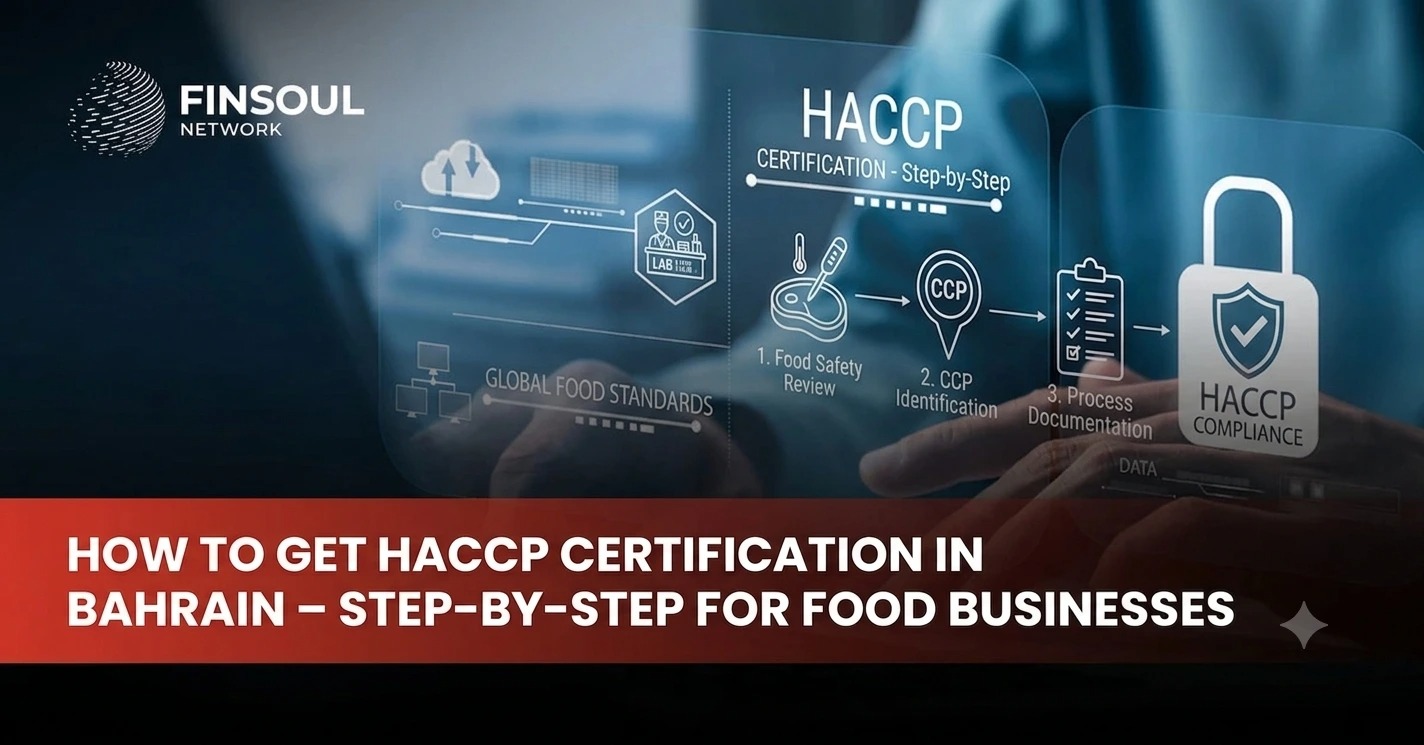
The HACCP certification process Bahrain businesses generally follow looks like this, regardless of which certification body issues the final certificate.
Gap Assessment
A consultant or internal food safety lead reviews current practices against the seven principles and flags where documentation or infrastructure falls short.
Build the HACCP Plan
The hazard analysis, CCPs, critical limits, and monitoring procedures get documented in detail, specific to your actual menu or production process rather than copied from a generic template.
Implement and Train Staff
Procedures only count if the floor staff actually follow them. Training covers hygiene, temperature monitoring, record-keeping, and what to do when something falls outside a critical limit.
Run Internal Checks
Before bringing in an external auditor, test the system against itself. Internal checks catch gaps that are cheap to fix now and embarrassing to discover during a paid audit.
Select an Accredited Certification Body
Look for a body recognized under the Gulf Accreditation Center (GAC) or another internationally recognized framework, since an unaccredited certificate carries far less weight with buyers.
Complete the Certification Audit
The auditor reviews documentation and conducts an on-site inspection, checking that your CCPs, monitoring records, and corrective action logs match what is actually happening on the floor.
Receive Certification and Maintain It
Once approved, the certificate is typically valid for three years, with annual surveillance audits confirming the system is still being followed, not shelved after the first audit.
Most businesses moving through this full HACCP certification process Bahrain sequence with reasonable readiness complete it within four to eight weeks, though larger or multi-site operations often need longer.
Finding the Right HACCP Consultant for Your Business
Plenty of food businesses attempt HACCP implementation in-house, and some succeed. Most, however, find that bringing in experienced HACCP consultants Bahrain food operators already trust shortens the timeline and reduces nonconformities raised at the certification audit.
A good consultant walks your specific kitchen or production floor, maps your actual hazard points, and builds a plan matching how the business really operates day to day. When comparing HACCP consultants Bahrain has to offer, ask how many audits in your specific sector, whether bakery, dairy, catering, or seafood processing, they have actually supported, since the hazard profile differs between categories.
HACCP Certification Bahrain: Cost and Timeline
Pricing for HACCP certification Bahrain food businesses pursue varies by size, operational complexity, and how much consultancy support is involved versus handled internally. A single-site restaurant with a simple menu typically costs less to certify than a multi-line manufacturing facility with several product categories to document.
Beyond consultancy fees, budget for staff training time, any physical upgrades an auditor flags (extra thermometers, better storage labeling, upgraded handwashing stations), and the certification body’s audit fee. Renewal costs run lower than initial certification, since surveillance audits are narrower in scope. At Finsoul Network Bahrain, we typically map this cost out for clients before they commit, so there are no surprises mid-process.
HACCP vs. ISO 22000: Which Does Your Business Need?
These two are related but not identical. HACCP is a method, the seven principles above, focused on identifying and controlling hazards. ISO 22000 is a full food safety management system that incorporates HACCP alongside broader requirements around management commitment and continual improvement.
A single-site restaurant or small manufacturer usually finds standalone HACCP certification sufficient. Larger exporters or businesses supplying multinational retail chains increasingly need ISO 22000, since it wraps HACCP inside a framework international buyers recognize more readily.
Common Pitfalls During the Certification Audit
- A HACCP plan copied from a template and never adapted to the business’s actual process
- Monitoring records with gaps on busy days, which auditors read as the system not really being followed
- Staff who cannot explain what a critical control point is when asked during the audit
- Corrective action logs showing problems but no evidence anyone fixed them
- Treating the certificate as a one-time achievement rather than an ongoing discipline
Conclusion
HACCP certification in Bahrain rewards food businesses that treat it as a genuine operational upgrade rather than paperwork assembled the week before an audit. Mapping your real hazards, training your team properly, and testing the system internally before the certification body ever walks in is what separates a smooth audit from a stressful one. Finsoul Network Bahrain supports food businesses through every stage of this process, from the initial gap assessment through to certification and renewal, so get in touch if you want a clear plan before you start.
Frequently Asked Questions
How to get HACCP certification in Bahrain?
To get HACCP certification in Bahrain, run a gap assessment against the seven HACCP principles, build a hazard analysis and monitoring plan specific to your operation, train your staff, complete internal checks, then pass an audit with an accredited certification body to receive your certificate.
Is HACCP certification mandatory for restaurants in Bahrain?
Not universally by law, though baseline food safety and municipal licensing always apply. HACCP certification itself becomes effectively necessary when a restaurant supplies institutional clients, large retailers, or hotel groups that require it as a supplier condition.
How long does HACCP certification take in Bahrain?
Most businesses complete the process in four to eight weeks with reasonable preparation, though larger or multi-site operations with more complex processes often need additional time.
What is the difference between HACCP and a food safety license in Bahrain?
A food safety or municipal license is the legal baseline every food establishment needs to operate, covering premises approval and basic hygiene compliance. HACCP certification is a separate, more detailed credential focused specifically on hazard analysis and control throughout production.
Do small food businesses need HACCP consultants in Bahrain?
Not strictly, but most small businesses find that working with consultants shortens the timeline and avoids costly nonconformities at audit, particularly if no one on staff has prior food safety system experience.