
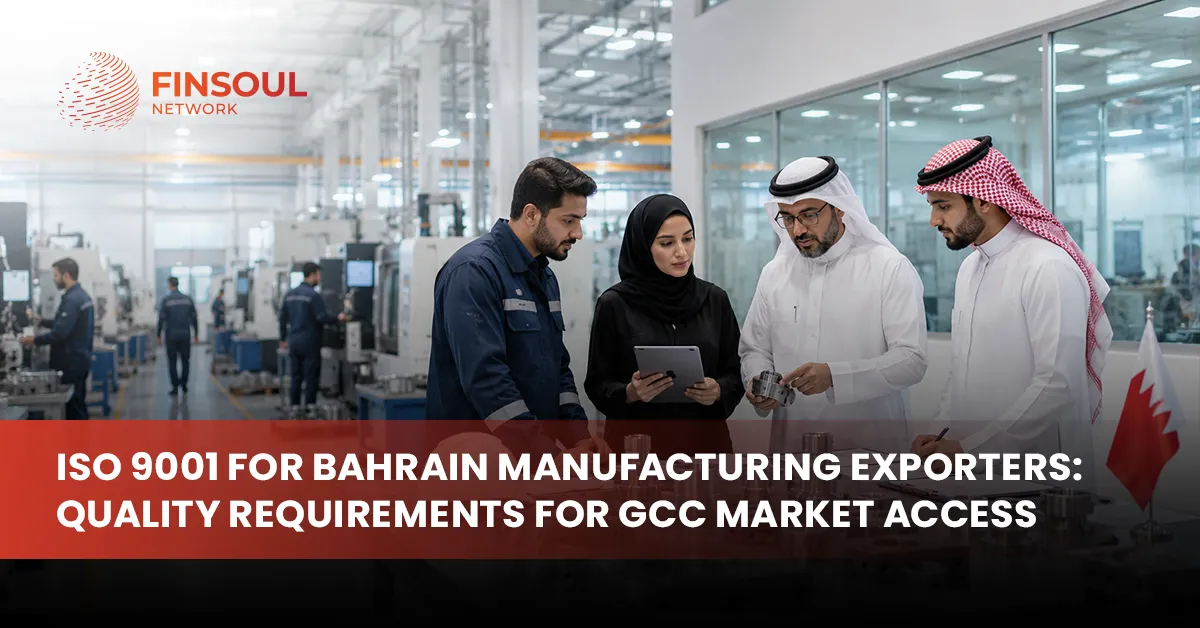
Bahrain’s manufacturing sector is expanding rapidly as exporters look to strengthen their footprint across the Gulf Cooperation Council region. For companies aiming to compete on price, quality, and reliability, ISO 9001 for manufacturing companies has become the baseline expectation rather than an optional extra. At Finsoul Network Bahrain, we work with local exporters who need practical guidance on turning quality management from a paperwork exercise into a genuine competitive advantage. This guide breaks down every subtopic a Bahrain-based manufacturer needs to understand before pursuing certification.
What Is ISO 9001 for Manufacturing Companies?
ISO 9001 is the internationally recognized standard for quality management systems (QMS). It defines the criteria a manufacturer must meet to consistently produce goods that satisfy customer and regulatory requirements. For any exporter, ISO 9001 for manufacturing companies is not just a certificate on the wall; it is a documented system covering process control, risk management, supplier evaluation, and continual improvement. Buyers across the GCC increasingly ask for proof of this system before signing supply contracts, which makes the standard a practical market-access tool rather than a bureaucratic checkbox.
Why GCC Market Access Depends on ISO 9001 Certification Bahrain
The GCC Standardization Organization (GSO) and national bodies such as Bahrain’s Ministry of Industry and Commerce reference internationally recognized quality frameworks when evaluating imported and locally manufactured goods. Without ISO 9001 certification Bahrain, manufacturers often struggle to clear tender pre-qualification stages in Saudi Arabia, the UAE, Qatar, Kuwait, and Oman. Large GCC buyers, particularly in construction materials, food processing, and industrial equipment, use certification as a shortlisting filter. In practice, this factor often separates a shortlisted bidder from an excluded one.
Core ISO 9001 Requirements Bahrain Manufacturers Must Meet
Understanding the specific ISO 9001 requirements Bahrain exporters face is the first real step toward certification. The standard is built around several clauses that every factory must implement:
- Context of the organization: identifying internal and external issues affecting quality
- Leadership commitment: management must actively own the quality policy
- Planning: risk-based thinking and defined quality objectives
- Support: competent staff, calibrated equipment, and controlled documentation
- Operation: process control from raw material intake to finished goods dispatch
- Performance evaluation: internal audits, customer satisfaction tracking, and management review
- Improvement: corrective actions and continual system refinement
These clauses apply regardless of factory size, but the depth of documentation typically scales with production complexity, which is why ISO 9001 requirements Bahrain manufacturers face can look different for a small workshop versus a large-scale exporter.
Step-by-Step Certification Process for ISO 9001 for Manufacturers Bahrain
Most Bahrain factories follow a similar path when pursuing ISO 9001 for manufacturers Bahrain certification:
- Gap analysis – comparing current practices against the standard’s requirements
- QMS documentation – writing quality manuals, procedures, and work instructions
- Staff training – ensuring employees understand their roles within the system
- Internal audit – testing the system before external review
- Management review – leadership formally evaluates system performance
- Certification audit – conducted in two stages by an accredited body
- Certificate issuance – valid for three years, subject to annual surveillance audits
Each stage builds on the last, and skipping steps is the most common reason factories fail their first certification audit.
Documentation and Quality Management System Essentials
A functioning QMS needs more than a binder of policies. Manufacturers pursuing ISO 9001 for manufacturing companies status need traceable records: incoming material inspection logs, machine calibration records, non-conformance reports, and corrective action logs. Auditors specifically check whether documented procedures match what actually happens on the shop floor. Exporters that treat documentation as a living system updated after every audit finding tend to pass surveillance audits with far fewer non-conformities than those who treat it as a one-time project.
Benefits of ISO 9001 for Manufacturing Companies in Bahrain
Beyond opening doors to GCC buyers, certification delivers measurable operational gains for ISO 9001 for manufacturing companies:
- Reduced scrap and rework through standardized process control
- Fewer customer complaints thanks to consistent output quality
- Stronger supplier relationships from structured vendor evaluation
- Easier onboarding of new staff using documented work instructions
- Improved eligibility for government tenders and export incentive programs
Many Bahrain manufacturers report that internal efficiency gains pay for the certification cost within the first year, independent of any new export contracts won.
Common Challenges Bahrain Exporters Face During Certification
Factories new to formal quality systems often underestimate three things: the time required to train staff on new procedures, the discipline needed to maintain records consistently, and the cultural shift from reactive problem-solving to proactive risk management. Smaller manufacturers pursuing ISO 9001 certification Bahrain sometimes attempt to copy generic templates without adapting them to their actual processes, which auditors flag quickly. Working with a consultant familiar with Bahrain’s regulatory environment and GCC buyer expectations significantly reduces the risk of failed audits.
Cost and Timeline Considerations
For Bahrain manufacturers, the cost and timeline of ISO 9001 certification depend mainly on company size, number of employees, operational complexity, and the maturity of the existing QMS.
| Key Factor | What to Expect |
| Timeline | Small manufacturers: 4–6 months; larger operations: 9–12 months |
| Consultancy & Training | Costs for QMS implementation, staff training, and process development |
| Internal Audits | Required to verify the QMS before the certification audit |
| Certification Fees | Fees charged by the certification body based on audit scope and company size |
| Ongoing Costs | Annual surveillance audits and three-year recertification |
| Main Cost Drivers | Employees, sites, production complexity, and existing documentation |
Plan your ISO 9001 investment early to avoid unexpected costs and certification delays.
Choosing the Right Certification Body for ISO 9001 for Manufacturers Bahrain
Check Accreditation
Manufacturers should confirm that the certification body is accredited by a recognized accreditation forum member. Unaccredited certificates may not be accepted during GCC tender pre-qualification.
Consider Industry Experience
Look for auditors with experience in Bahrain’s manufacturing sectors, including food processing, metal fabrication, plastics, and industrial equipment. Industry knowledge helps ensure the audit focuses on relevant processes rather than generic checklist items.
Compare Audit and Support Services
When comparing certification bodies, consider audit scheduling, turnaround times, auditor expertise, and post-certification support for surveillance audits.
Work With a Local Consultant
A local consultant can help translate ISO 9001 requirements into practical procedures suited to your factory. This can reduce major non-conformities and help shorten the certification timeline for ISO 9001 for manufacturing companies.
ISO 9001 and Other Standards GCC Buyers Look For
While ISO 9001 covers quality management broadly, many GCC buyers, particularly in construction, oil and gas services, and food manufacturing, also expect complementary certifications such as ISO 14001 for environmental management or ISO 45001 for occupational health and safety. Manufacturers building a long-term export strategy often pursue these standards in sequence, using the existing quality management foundation as the base for an integrated system. This approach avoids duplicating documentation across multiple standards and gives auditors a single, coherent system to review, which typically speeds up subsequent certification audits.
Maintaining Certification: Audits and Continuous Improvement
Certification does not end once the certificate is issued. Accredited bodies conduct annual surveillance audits to confirm the QMS remains active and effective. Manufacturers holding ISO 9001 certification Bahrain status must keep internal audit schedules current, close corrective actions promptly, and refresh staff training as processes evolve. Companies that treat these audits as routine business checkpoints, rather than emergencies, maintain stronger, more resilient quality systems over time and reinforce their standing as reliable ISO 9001 for manufacturing companies across the region.
Conclusion
For Bahrain’s manufacturing exporters, quality management is no longer a differentiator; it is the entry ticket to GCC market access. Investing in ISO 9001 certification for manufacturing companies builds the operational discipline, documentation, and customer trust needed to compete regionally. Finsoul Network Bahrain helps manufacturers navigate every stage of this journey, from initial gap analysis through certification and ongoing surveillance audits, so exporters can focus on production while building a quality system that genuinely supports growth.
Ready to Make ISO 9001 a Competitive Advantage?
Make your manufacturing business GCC-ready with a practical, audit-ready ISO 9001 system. Finsoul Network Bahrain can support you from gap analysis and documentation to certification.
Build stronger quality processes, improve customer confidence, and prepare your business for new GCC opportunities.
Get expert guidance tailored to your manufacturing operations and certification goals.
Contact Finsoul Network Bahrain today and get started.
Office Address: Office 41, Building 2737, Road 3649, Seef, Al Manama 436, Bahrain
Email: info@finsoulnetwork.com
Phone: +973 3383 2422
Frequently Asked Questions
How long does ISO 9001 certification take for a Bahrain manufacturer?
Most factories complete the process in four to nine months, depending on size and how developed their existing documentation already is.
Is ISO 9001 certification mandatory for exporting to GCC countries?
It’s not always legally mandatory, but most large buyers and government tenders across the GCC require it as a practical prerequisite.
What is the validity period of an ISO 9001 certificate?
Certificates are valid for three years, with mandatory annual surveillance audits needed to keep them active.
Can a small manufacturing workshop in Bahrain get ISO 9001 certified?
Yes, the standard applies to businesses of any size; documentation is simply scaled to match the complexity of operations.
What happens if a company fails its certification audit?
The certification body issues non-conformity reports, and the manufacturer must implement corrective actions before a follow-up audit is scheduled.