
Blog

ISO 9001 for manufacturing companies
Blog

ISO 9001 for Bahrain Manufacturing Exporters: Quality Requirements for GCC Market Access

Bahrain’s manufacturing sector is expanding rapidly as exporters look to strengthen their footprint across the Gulf Cooperation Council region. For companies aiming to compete on price, quality, and reliability, ISO 9001 for manufacturing companies has become the baseline expectation rather than an optional extra. At Finsoul Network Bahrain, we work with local exporters who need practical guidance on turning quality management from a paperwork exercise into a genuine competitive advantage. This guide breaks down every subtopic a Bahrain-based manufacturer needs to understand before pursuing certification. What Is ISO 9001 for Manufacturing Companies? ISO 9001 is the internationally recognized standard for quality management systems (QMS). It defines the criteria a manufacturer must meet to consistently produce goods that satisfy customer and regulatory requirements. For any exporter, ISO 9001 for manufacturing companies is not just a certificate on the wall; it is a documented system covering process control, risk management, supplier evaluation, and continual improvement. Buyers across the GCC increasingly ask for proof of this system before signing supply contracts, which makes the standard a practical market-access tool rather than a bureaucratic checkbox. Why GCC Market Access Depends on ISO 9001 Certification Bahrain The GCC Standardization Organization (GSO) and national bodies such as Bahrain’s Ministry of Industry and Commerce reference internationally recognized quality frameworks when evaluating imported and locally manufactured goods. Without ISO 9001 certification Bahrain, manufacturers often struggle to clear tender pre-qualification stages in Saudi Arabia, the UAE, Qatar, Kuwait, and Oman. Large GCC buyers, particularly in construction materials, food processing, and industrial equipment, use certification as a shortlisting filter. In practice, this factor often separates a shortlisted bidder from an excluded one. Core ISO 9001 Requirements Bahrain Manufacturers Must Meet Understanding the specific ISO 9001 requirements Bahrain exporters face is the first real step toward certification. The standard is built around several clauses that every factory must implement: Context of the organization: identifying internal and external issues affecting quality Leadership commitment: management must actively own the quality policy Planning: risk-based thinking and defined quality objectives Support: competent staff, calibrated equipment, and controlled documentation Operation: process control from raw material intake to finished goods dispatch Performance evaluation: internal audits, customer satisfaction tracking, and management review Improvement: corrective actions and continual system refinement These clauses apply regardless of factory size, but the depth of documentation typically scales with production complexity, which is why ISO 9001 requirements Bahrain manufacturers face can look different for a small workshop versus a large-scale exporter. Step-by-Step Certification Process for ISO 9001 for Manufacturers Bahrain Most Bahrain factories follow a similar path when pursuing ISO 9001 for manufacturers Bahrain certification: Gap analysis – comparing current practices against the standard’s requirements QMS documentation – writing quality manuals, procedures, and work instructions Staff training – ensuring employees understand their roles within the system Internal audit – testing the system before external review Management review – leadership formally evaluates system performance Certification audit – conducted in two stages by an accredited body Certificate issuance – valid for three years, subject to annual surveillance audits Each stage builds on the last, and skipping steps is the most common reason factories fail their first certification audit. Documentation and Quality Management System Essentials A functioning QMS needs more than a binder of policies. Manufacturers pursuing ISO 9001 for manufacturing companies status need traceable records: incoming material inspection logs, machine calibration records, non-conformance reports, and corrective action logs. Auditors specifically check whether documented procedures match what actually happens on the shop floor. Exporters that treat documentation as a living system updated after every audit finding tend to pass surveillance audits with far fewer non-conformities than those who treat it as a one-time project. Benefits of ISO 9001 for Manufacturing Companies in Bahrain Beyond opening doors to GCC buyers, certification delivers measurable operational gains for ISO 9001 for manufacturing companies: Reduced scrap and rework through standardized process control Fewer customer complaints thanks to consistent output quality Stronger supplier relationships from structured vendor evaluation Easier onboarding of new staff using documented work instructions Improved eligibility for government tenders and export incentive programs Many Bahrain manufacturers report that internal efficiency gains pay for the certification cost within the first year, independent of any new export contracts won. Common Challenges Bahrain Exporters Face During Certification Factories new to formal quality systems often underestimate three things: the time required to train staff on new procedures, the discipline needed to maintain records consistently, and the cultural shift from reactive problem-solving to proactive risk management. Smaller manufacturers pursuing ISO 9001 certification Bahrain sometimes attempt to copy generic templates without adapting them to their actual processes, which auditors flag quickly. Working with a consultant familiar with Bahrain’s regulatory environment and GCC buyer expectations significantly reduces the risk of failed audits. Cost and Timeline Considerations For Bahrain manufacturers, the cost and timeline of ISO 9001 certification depend mainly on company size, number of employees, operational complexity, and the maturity of the existing QMS. Key Factor What to Expect Timeline Small manufacturers: 4–6 months; larger operations: 9–12 months Consultancy & Training Costs for QMS implementation, staff training, and process development Internal Audits Required to verify the QMS before the certification audit Certification Fees Fees charged by the certification body based on audit scope and company size Ongoing Costs Annual surveillance audits and three-year recertification Main Cost Drivers Employees, sites, production complexity, and existing documentation Plan your ISO 9001 investment early to avoid unexpected costs and certification delays. Choosing the Right Certification Body for ISO 9001 for Manufacturers Bahrain Check Accreditation Manufacturers should confirm that the certification body is accredited by a recognized accreditation forum member. Unaccredited certificates may not be accepted during GCC tender pre-qualification. Consider Industry Experience Look for auditors with experience in Bahrain’s manufacturing sectors, including food processing, metal fabrication, plastics, and industrial equipment. Industry knowledge helps ensure the audit focuses on relevant processes rather than generic checklist items. Compare Audit and Support Services When comparing certification bodies, consider audit scheduling, turnaround times, auditor expertise, and post-certification support for surveillance audits. Work

ISO 13485 Bahrain medical devices
Blog

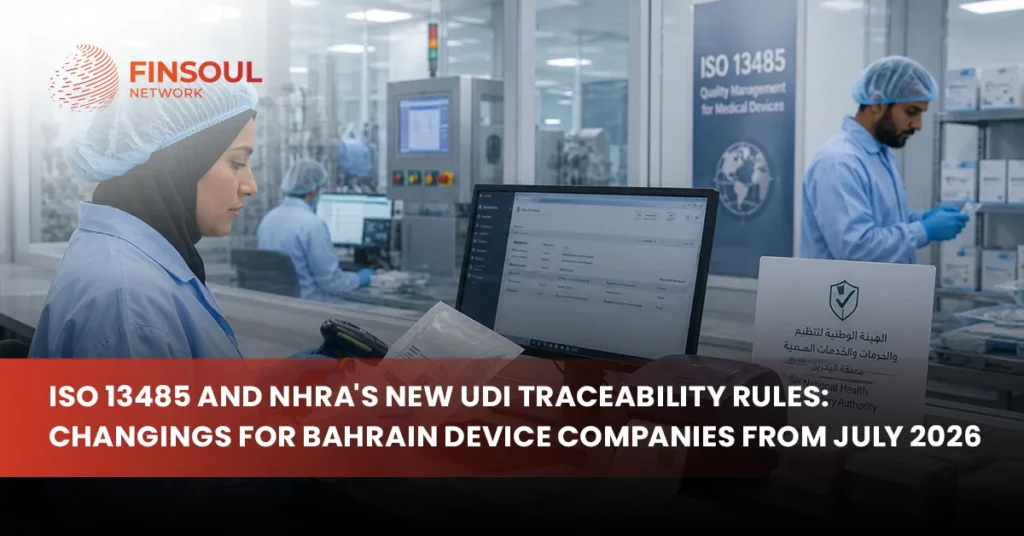
ISO 13485 and NHRA’s New UDI Traceability Rules: Changings for Bahrain Device Companies from July 2026

Bahrain’s National Health Regulatory Authority is rolling out new Unique Device Identification traceability rules starting July 2026, and medical device companies operating locally have a narrow window to adjust. These rules do not exist in isolation. They sit directly on top of the quality system requirements already built into ISO 13485 Bahrain medical devices manufacturers, and distributors are expected to hold. Finsoul Network Bahrain has been tracking this regulatory shift closely, and this article explains exactly what changes, when it takes effect, and what device companies need to do before the deadline arrives. What NHRA’s New UDI Traceability Rules Actually Change Unique Device Identification, or UDI, assigns a distinct code to every medical device so it can be tracked from manufacture through to the point of use. NHRA’s updated rules require device companies to record and report UDI data at each stage of distribution inside Bahrain, closing a gap that previously relied on manual, inconsistent tracking between manufacturers, distributors, and healthcare facilities. For companies already running a certified quality system, this is less disruptive than it sounds. The traceability logic NHRA is asking for maps closely onto the device history and risk records that ISO 13485 requirements Bahrain auditors already check during certification, which means the new rule is really an extension of existing obligations rather than a separate compliance track. Timeline: What Changes From July 2026 NHRA has phased the rollout rather than switching everything on at once. Device companies should track these milestones: Timeline Requirement July 2026 UDI reporting becomes mandatory for Class C and D devices entering the Bahrain market. October 2026 Distributors must confirm UDI data at each transfer point in the supply chain. January 2027 Full traceability reporting extends to Class A and B devices. Ongoing NHRA reserves the right to audit UDI records during routine facility inspections. Companies already certified under ISO 13485 Bahrain medical devices procedures generally have less catching up to do at each milestone, since the device history record and traceability clauses already required by the standard cover much of what NHRA is now asking for in a formal reporting format. How This Connects to ISO 13485 Certification Bahrain Companies Already Hold ISO 13485 is the international standard for medical device quality management systems. ISO 13485 certification Bahrain device makers and distributors pursue covers design control, risk management, supplier evaluation, and post-market surveillance, alongside the record-keeping NHRA now wants tied to UDI data specifically. ISO 13485 is the international standard for medical device quality management systems. ISO 13485 Bahrain medical devices certification covers design control, risk management, supplier evaluation, and post-market surveillance, alongside the record-keeping NHRA now wants tied to UDI data specifically. ISO 13485 Requirements Bahrain Device Makers Must Meet Beyond the UDI question, ISO 13485 requirements Bahrain regulators expect include a documented quality manual, defined management responsibility, controlled design and development processes, and a corrective action system that closes the loop on complaints and non-conformities. Device companies preparing for certification for the first time often underestimate the design control clauses. These require evidence that risk was assessed at every stage of product development, not only right before launch, which is exactly the kind of record NHRA inspectors will want to see referenced during a UDI audit. Building UDI Traceability Into an Existing Quality Management System The practical fix is to treat UDI reporting as an extension of the device history record most certified companies already maintain under ISO 13485 Bahrain medical devices clauses on identification and traceability. Most companies need to work through a short list of tasks rather than build anything from scratch: Map UDI codes to existing batch and lot records Assign a system owner responsible for NHRA reporting Update supplier agreements to require UDI data at handover Test the reporting format against NHRA’s submission portal before July 2026 Brief the quality team, so UDI questions during a certification audit don’t catch anyone off guard Who Actually Falls Under These Rules The new requirements are not limited to large multinational device makers with a Bahrain office. Local distributors importing Class C and D devices, contract manufacturers producing under a Bahrain-registered label, and even smaller clinics that repackage or relabel devices before resale all fall inside the scope in practice. Companies that assumed UDI reporting was a manufacturer-only concern are often surprised to learn that distributors carry reporting obligations too. Anyone in the supply chain who holds ISO 13485 Bahrain medical devices certification already has a system built to capture this kind of data, which makes the transition considerably smoother than for companies starting from a blank slate. Risks of Missing the July 2026 Deadline Companies that miss the deadline risk more than a compliance notice. NHRA can restrict market access for non-compliant device categories, and distributors may refuse to carry products without verified UDI data attached to the shipment. For companies without valid medical device certification Bahrain authorities recognise, the UDI rules add a second layer of exposure on top of an already incomplete compliance picture, since neither the quality system nor the traceability data would meet the bar on their own. How Bahrain Device Companies Should Prepare Preparing early can help companies identify gaps in their quality systems, UDI data, and reporting processes before the July 2026 rollout. Companies preparing for ISO 13485 certification: Integrate UDI readiness into the same certification project rather than treating them as separate initiatives. Traceability procedures reviewed during certification can overlap with the information NHRA inspectors may request later. Companies already holding recognised certification: Focus primarily on the data and reporting gap. Existing quality procedures may already be in place and can be connected to NHRA’s required submission format. Conduct an internal readiness review: Review current procedures against the July 2026 milestones to identify missing UDI data, responsibilities, documentation, and reporting processes. Start certification early: Companies planning to pursue ISO 13485 certification should avoid waiting until the regulatory deadline approaches. Starting early can provide more time for documentation, implementation, and audit scheduling. Companies without existing certification: Allow additional time to

ISO 45001 for Bahrain Oil & Gas Contractors
Blog

ISO 45001 for Bahrain Oil & Gas Contractors: Bapco and EWA Vendor Safety Prequalification

Winning a vendor contract with Bapco or the Electricity and Water Authority (EWA) is no longer just about price or delivery speed. Both buyers have tightened their vendor prequalification rules, and safety documentation now sits near the top of the checklist. Contractors without a certified occupational health and safety system are getting filtered out before the technical evaluation even begins.  This is why ISO 45001 for oil and gas contractors has become a near non-negotiable credential for firms bidding on Bahrain’s energy sector work. Finsoul Network Bahrain has guided contractors across the sector through this exact prequalification process, and this guide breaks down what Bapco and EWA actually check, and how to get certified without losing months to paperwork. Why Bapco and EWA Are Raising the Safety Bar Bahrain’s two largest energy and utility buyers have both revised their contractor onboarding frameworks in recent years. Both now request proof of a working OH&S management system Bahrain auditors have actually verified, not just an internal policy document sitting in a drawer somewhere. The shift reflects a wider regional pattern. Rising insurance costs, stricter incident reporting rules, and pressure from international partners have pushed procurement teams to treat safety certification as a hard gate rather than a bonus. A contractor without ISO 45001 certification Bahrain assessors have signed off on is often removed from the shortlist automatically, regardless of technical strength. What ISO 45001 for Oil and Gas Contractors Actually Covers ISO 45001 is the international standard for occupational health and safety management systems. For contractors operating on refineries, pipelines, or utility sites, ISO 45001 for oil and gas contractors requires a documented system covering hazard identification, worker participation, incident investigation, and continual improvement. A safety manual alone no longer meets the bar. Unlike the older OHSAS 18001 certificates some contractors still hold, ISO 45001 places heavier weight on leadership accountability and worker consultation. This matters directly for Bahrain’s ISO 45001 Bahrain oil and gas contractor pool, since Bapco and EWA reviewers increasingly ask for proof that site supervisors, not only HSE managers, understand and apply the system day to day. Who Actually Needs This Certification Not every subcontractor on a Bapco or EWA site needs to hold the certificate directly, but the pool of companies that do is wider than most owners expect. Civil, mechanical, electrical, and instrumentation contractors bidding on maintenance, shutdown, or capital project work all fall inside the requirement in practice, even when the tender document does not spell it out explicitly. Smaller subcontractors sometimes assume the requirement only applies to the main EPC contractor. That assumption tends to backfire during site mobilisation, when the primary contractor’s own safety plan requires every party on site, including sub-tier vendors, to demonstrate an equivalent OH&S management system Bahrain reviewers can trace back to a valid certificate. Building the ISO 45001 for oil and gas contractors framework early avoids being the one vendor holding up mobilisation while paperwork gets sorted out under deadline pressure. Choosing a Certification Body in Bahrain Not all certificates carry equal weight with Bapco and EWA procurement teams. Both buyers generally expect certification from a body accredited under a recognised international accreditation forum member, rather than a locally issued certificate with no accreditation trail behind it. Before committing to a certification body, contractors should confirm three things: the body’s accreditation status, its experience certifying oil, gas, or utility contractors specifically, and its typical audit turnaround time. A body unfamiliar with site-based hazards common to refinery or pipeline work tends to produce a slower, less useful audit than one with direct sector experience. Bapco vs EWA: What Each Buyer Checks During Prequalification Bapco and EWA don’t run identical checklists, but the overlap is large enough that most contractors can prepare for both with a single certification effort. The table below shows what each buyer typically asks for during vendor review. Requirement Bapco Vendors EWA Vendors Certified OH&S system ISO 45001 required for high-risk scopes ISO 45001 required for site-based contracts Audit evidence Certificate plus latest audit report Certificate plus incident log review Renewal check Annual vendor file review Contract-cycle review Worker training records Mandatory, updated yearly Mandatory, updated per project Getting Ready: Steps Toward ISO 45001 for Oil and Gas Contractors Certification Contractors preparing for ISO 45001 for oil and gas contractors certification who rush the process usually fail their first surveillance audit. A steadier path looks like this: Gap Assessment Compare current safety practices against the ISO 45001 clauses. This step usually surfaces the biggest documentation gaps early, before they cost time later in the process. Build the Management System Document hazard registers, risk assessments, emergency procedures, and defined roles. This becomes the backbone of the OH&S management system Bahrain assessors will test during the audit. Train Supervisors and Site Workers Bapco and EWA both check training records closely. Everyone from site supervisors to subcontracted labour needs to understand their role in the system, not just sign an attendance sheet. Run an Internal Audit An internal audit, followed by a management review, catches weak points before an external certification body does. This step separates contractors who pass first time from those who need repeat visits. Certification Audit with an Accredited Body The final step is a two-stage audit by an accredited certification body. Once passed, the certificate becomes the document Bapco and EWA procurement teams will ask to see first. Common Challenges Bahrain Contractors Run Into A few issues repeatedly block contractors from finishing their ISO 45001 for oil and gas contractors application on time: Safety documents exist but are not linked to actual site practice Subcontractor records are missing or incomplete Training records are outdated by the time of the audit Site supervisors cannot explain the system when auditors ask direct questions Companies apply for certification too close to a tender deadline Why ISO 45001 Bahrain Oil and Gas Certification Pays Off Beyond Prequalification Certification is not only a box to tick for Bapco or EWA. Contractors with a functioning OH&S management system Bahrain regulators

ISO audit in Bahrain
Blog

Why Most Bahraini Companies Fail Their First ISO Audit

Every year, a familiar scene plays out across Manama’s industrial and business districts: a company spends weeks preparing documents, briefing staff, and rehearsing answers, only to walk away from its first ISO audit in Bahrain with a list of non-conformities. At Finsoul Network Bahrain, we have sat across the table from dozens of business owners who assumed certification was a formality, not a test of how their operations actually run day to day. The gap between paperwork and practice is usually where a first attempt collapses, and understanding that gap is the first step toward closing it. The Real Cost of Failing an ISO Audit in Bahrain A failed audit is rarely just a scheduling delay. It means re-inspection fees, lost tender eligibility, and weeks of internal disruption while teams scramble to fix gaps that should have been caught earlier. For companies bidding on government or GCC contracts, a stalled ISO audit in Bahrain can quietly knock them out of contention before a client ever sees a proposal. The financial hit is real, but the credibility hit often lasts longer, especially in industries where clients specifically ask for certification status before signing. Bahrain’s growing focus on quality and safety standards across manufacturing, logistics, healthcare, and construction has pushed more businesses toward certification than ever before. Yet the pace of demand has outstripped the pace of preparation, and that mismatch is exactly where first-time failures cluster. Understanding the ISO Certification Audit Bahrain Process Before diving into why companies stumble, it helps to know what an ISO certification audit Bahrain businesses go through actually involves. Certification is not a single event. It is a two-stage review carried out by an accredited body, followed by ongoing surveillance visits to confirm the system stays functional after the certificate is issued. Stage 1: Documentation Review The auditor checks whether your management system documents, policies, and procedures meet the requirements of the chosen standard, whether that is ISO 9001, ISO 14001, or ISO 45001. Stage 2: Implementation Review This is where most gaps surface. Auditors interview staff, observe workflows, and compare what is written against what actually happens on the shop floor or in the office. A well-run stage 2 review can feel almost anticlimactic for a prepared company, while an unprepared one will find every weak link exposed within the first few interviews. Between these two stages, some companies also request a readiness check with their certification body or an outside advisor. This is optional, but it catches surface-level gaps, missing signatures, outdated version numbers, and unclear ownership of documents that otherwise chip away at confidence during the formal review. Where Bahraini Companies Go Wrong: Top Failure Points Most first-time failures trace back to a handful of repeat issues rather than one dramatic mistake. The table below breaks down the patterns we see most often during an ISO audit in Bahrain. Common Failure Point Why It Happens Quick Fix Documented procedures don’t match daily practice Staff never trained on the actual written policy Run practical walkthroughs, not just document sign-offs No evidence of internal audits Internal audits treated as a formality or skipped entirely Schedule internal audits quarterly, keep dated records Incomplete corrective action records Issues get fixed verbally but never logged Log every non-conformity with a closure date and owner Untrained employees during interviews Training happens once, then is never refreshed Build short refresher sessions before the audit window Missing risk assessments Risk management treated as paperwork, not a live process Review and update risk registers every six months ISO Audit Requirements Bahrain Businesses Often Overlook Meeting the ISO audit requirements Bahrain auditors expect goes beyond having a policy folder ready. Auditors want to see a functioning management system with a clear audit trail: minutes from management review meetings, records of employee competence, supplier evaluation logs, and evidence that corrective actions actually closed the loop. Companies that treat these as box-ticking exercises rather than working tools almost always struggle when questioned directly during the on-site visit. Smaller businesses in particular tend to underestimate how much record-keeping the standard expects. A five-person operations team can meet every requirement on paper, yet still fail if nobody can produce a dated record when the auditor asks for one. Keeping a simple, centralised log of training sessions, equipment checks, and management reviews solves this without adding real administrative burden. How the ISO Audit Process Bahrain Follows Stage by Stage Understanding the ISO audit process Bahrain certification bodies use helps remove the guesswork. After the two initial stages, a surveillance audit typically follows within 12 months, checking that the system is maintained rather than shelved once the certificate is framed on the wall. Recertification happens on a three-year cycle. Companies that treat the first ISO audit in Bahrain as the finish line, rather than the start of an ongoing discipline, tend to see their systems decay by the time surveillance visits arrive. Building Audit Readiness Before You Book Your Certification Readiness is built months in advance, not the week before the auditor arrives. A pre-assessment gap analysis, conducted internally or with an outside consultant, gives you an honest picture of where your ISO certification audit Bahrain attempt is likely to fail before it becomes official. This single step catches the majority of issues that would otherwise surface in front of the actual auditor. A realistic timeline helps too. Companies that give themselves eight to twelve weeks between the gap analysis and the actual audit date tend to walk in far calmer than those compressing the whole process into a few rushed weeks. Rushed preparation almost always shows up as inconsistent answers when different employees are asked the same question by the auditor. Practical Steps to Pass Your ISO Audit in Bahrain the First Time Conduct a full internal audit at least six weeks before the scheduled date Train department heads to explain their own processes without reading from a script Cross-check that every procedure document reflects what staff genuinely do Close out old corrective actions with documented evidence,

ISO certification for businesses Bahrain
Blog

ISO 9001 vs ISO 45001 vs ISO 27001: Which Certification Bahrain Business Actually Need?

Bahrain’s economy is growing fast, and with growth comes competition from local rivals and from companies chasing government tenders and international contracts. This is exactly where ISO certification for businesses Bahrain becomes a real deciding factor. Buyers, regulators, and partners increasingly ask for proof that a company follows recognized international standards before they sign a deal. But not every certification fits every business.  The three most requested standards ISO 9001, ISO 45001, and ISO 27001 solve very different problems, and picking the wrong one wastes both time and budget. This guide breaks down what each standard covers, who needs it in Bahrain, and how Finsoul Network Bahrain helps companies choose and implement the right one. What Is ISO Certification and Why Does It Matter in Bahrain? ISO certification for businesses Bahrain simply means an independent, accredited body has audited your company and confirmed it meets an internationally recognized management standard. It’s not a one-time paper exercise; it’s an ongoing system that shapes how you run quality, safety, or data protection. For companies in Bahrain, ISO certification Bahrain has become almost a baseline expectation in sectors like construction, manufacturing, IT services, healthcare, and logistics. Tender documents for Tamkeen-backed projects, government contracts, and multinational partnerships often list ISO certification as a mandatory or scoring criterion. In short, it’s no longer just a “nice to have it’s a competitive necessity. ISO 9001: Quality Management System ISO 9001 is the world’s most widely adopted quality management standard. It focuses on consistency, making sure your products, services, and internal processes meet customer expectations every single time, not just occasionally. Getting ISO 9001 Bahrain certified means your business has documented processes, clear accountability, measurable quality objectives, and a system for continuous improvement. Businesses that benefit most from ISO 9001 Bahrain certification include manufacturers, contractors, trading companies, and service providers who deal with repeat clients and formal procurement processes. If your company regularly loses bids because a competitor has ISO, this is usually the certification they hold. It’s also the foundation most companies start with before adding sector-specific standards, making it a core part of any serious ISO certification for businesses Bahrain strategy. ISO 45001: Occupational Health and Safety Management ISO 45001 is built around one goal: reducing workplace injuries, illness, and risk. It replaced the older OHSAS 18001 standard and is now the global benchmark for occupational health and safety systems. ISO 45001 Bahrain certification requires businesses to identify hazards, assess risks, set safety controls, train staff, and continuously monitor incidents. This standard is essential for construction firms, oil and gas contractors, manufacturing plants, and any business with a physical worksite where employees face operational risk. Bahrain’s construction and industrial sectors, in particular, are seeing more clients demand ISO 45001 Bahrain compliance before awarding contracts, since it directly protects workers and reduces liability. For companies that put people on-site daily, this is often the most urgent piece of their broader ISO certification for businesses Bahrain plan. ISO 27001: Information Security Management ISO 27001 governs how a business protects information, customer data, financial records, intellectual property, and internal systems. As Bahrain positions itself as a regional fintech and digital services hub, ISO 27001 Bahrain certification has become increasingly important for banks, fintech startups, IT firms, healthcare providers, and any company handling sensitive client data. Achieving ISO 27001 Bahrain status means implementing an Information Security Management System (ISMS): access controls, encryption practices, incident response plans, staff awareness training, and regular risk assessments. With Bahrain’s data protection law (PDPL) enforcement tightening and cyber threats rising across the Gulf, this certification is quickly becoming as important as ISO 9001 for any digitally-driven business pursuing serious ISO certification for businesses Bahrain. ISO 9001 vs ISO 45001 vs ISO 27001: Quick Comparison Standard Focus Area Best For Key Outcome ISO 9001 Quality Management Manufacturers, contractors, service firms Consistent product/service quality ISO 45001 Occupational Health & Safety Construction, industrial, on-site teams Fewer workplace incidents ISO 27001 Information Security Fintech, IT, healthcare, data-heavy firms Protected, compliant data systems Many businesses in Bahrain don’t stop at one. A construction company might need both ISO 9001 and ISO 45001, while a fintech firm may prioritize ISO 27001 alongside ISO 9001 for client trust. Choosing the right combination is where a proper ISO certification for businesses Bahrain strategy really pays off. Which Industries in Bahrain Need Which Certification? Construction & contracting: ISO 45001 is near-mandatory; ISO 9001 strengthens bid competitiveness through ISO 9001 Bahrain accreditation. Manufacturing & industrial plants: Usually need both ISO 45001 Bahrain (worker safety) and ISO 9001 (product consistency). Banking, fintech & IT services: ISO 27001 Bahrain certification is often required by regulators and enterprise clients. Healthcare providers: A mix of ISO 9001 for service quality and ISO 27001 for patient data protection. Logistics & trading companies: ISO 9001 is the standard most frequently requested in tender documents. If you’re unsure which combination applies to your sector, that’s exactly the kind of decision ISO certification for businesses Bahrain consultants are meant to guide you through, rather than guessing and paying for a standard you don’t actually need. How to Choose and Implement the Right ISO Standard in Bahrain Picking between ISO 9001, ISO 45001, and ISO 27001 isn’t just about matching your industry to a checklist; it depends on your client base, tender requirements, risk exposure, and growth plans. A professional gap analysis can help identify which standard, or combination of standards, delivers the most value for your business and what needs to be addressed before the certification audit. Once the right standard is selected, implementation typically involves developing the required policies and procedures, assigning responsibilities, training employees, documenting processes, conducting internal audits, and addressing identified gaps. The implementation process should be built around how your business actually operates, ensuring that certification becomes a practical improvement rather than a paperwork burden. Expert guidance can also help businesses avoid unnecessary costs and choose the right ISO certification for businesses Bahrain based on their specific requirements and long-term goals. Conclusion Choosing between ISO 9001, ISO

ISO certification for government tenders
Blog

ISO Certification and Bahrain Government Tenders: The Exact Standards You Need to Qualify

Winning public sector contracts in the Kingdom is no longer just about price and experience; it’s about proof. Government bodies and semi-government entities now expect bidders to show recognized quality credentials before a bid is even shortlisted. This is exactly why ISO certification for government tenders has become one of the most searched compliance topics among contractors, suppliers, and consultants in Bahrain. At Finsoul Network Bahrain, we work with companies every week who are trying to understand which standards actually matter, how long certification takes, and what documentation tender committees expect to see. This guide breaks down every part of that journey. This shift isn’t unique to Bahrain procurement standards across the GCC have tightened as governments push for more accountable, professionally managed supply chains, but local contractors often underestimate how early they need to start preparing. Waiting until a tender is published to think about certification usually means missing the deadline entirely, since audits, documentation, and accreditation checks all take real time to complete properly. Why ISO Certification Matters for Government Tenders in Bahrain Public procurement in Bahrain follows strict evaluation criteria, and quality management credentials sit near the top of that list. When a tender document lists ISO certification for government tenders as a mandatory or preferred requirement, it’s because the awarding authority wants assurance that a bidder can consistently deliver work to a defined standard, manage risk, and maintain proper records. Bidders without recognized certification are often disqualified at the technical evaluation stage, regardless of how competitive their financial offer is. This is one reason ISO certification Bahrain tenders requirements have become stricter across construction, engineering, IT, and facilities management sectors over the past few years. Key ISO Standards Bahrain Government Tenders Usually Require Not every tender asks for the same standard, so understanding the exact ISO requirements for tenders Bahrain authorities set is essential before you invest time and money in certification. ISO 9001 (Quality Management): the most commonly requested standard across almost every sector, and often treated as the baseline for ISO certification for government tenders. ISO 14001 (Environmental Management): frequently required for construction, oil & gas, and infrastructure tenders. ISO 45001 (Occupational Health & Safety): mandatory for tenders involving site work, labor-intensive projects, or public safety. ISO 27001 (Information Security Management): increasingly required for IT, telecom, and data-handling government contracts. Reviewing the tender document line by line to confirm the exact ISO requirements for tenders Bahrain committees list is the first practical step, assuming the wrong standard is a common and costly error. Step-by-Step Process to Get ISO Certified in Bahrain Getting ISO certification in Bahrain follows a fairly structured path, though the timeline varies by company size and standard. Gap analysis assesses current processes against the chosen ISO standard. Documentation development builds the required policies, procedures, and records. Implementation rolls out the system across departments and trains staff. Internal audit verifies readiness before the external audit. Certification audit conducted by an accredited body in two stages. Certificate issuance valid for three years, with annual surveillance audits. Companies that plan ahead of an upcoming bid rather than rushing after a tender is published consistently have a smoother path to ISO certification for government tenders. Eligibility Criteria and Documentation Bidders Need Beyond the certificate itself, tender committees usually ask for supporting evidence. Meeting the full set of ISO requirements for tenders Bahrain authorities expect typically means having: A valid certificate from an accredited certification body (not a training or consultancy letter) Scope of certification matching the tender’s scope of work Commercial registration (CR) aligned with certified activities Internal audit reports and management review records available on request Missing even one of these can result in a technical disqualification, even if the company holds a genuine certificate. Tender committees typically cross-check the certificate number against the issuing body’s public register, so certificates that can’t be independently verified are treated the same as no certificate at all. This is one of the quieter reasons well-prepared bidders still get rejected. Common Mistakes Companies Make When Applying Many businesses lose tenders not because they lack quality processes, but because of avoidable errors: Choosing an unaccredited or unrecognized certification body Certifying the wrong scope of activities for the project Letting the certificate lapse before the tender closing date Underestimating the time needed before a bid deadline Treating certification as a one-time task instead of an ongoing system Avoiding these mistakes is often the real difference between qualifying and being rejected in the technical evaluation of ISO certification for government tenders. Cost and Timeline for ISO Certification in Bahrain The cost and timeline for ISO certification in Bahrain can vary depending on several factors, including the size of the business and the standard being pursued. Understanding these factors can help businesses plan the certification process more effectively and avoid unnecessary delays. Factor Details Cost Depends on company size, number of employees, and the ISO standard chosen Typical Timeline 6 to 12 weeks for most small and mid-sized businesses Process Duration From gap analysis through certificate issuance Key Requirement Documentation and implementation should progress without major delays Rushed Certification Possible when close to a tender deadline, but carries a higher risk of audit findings that may need correction before certification How ISO Certified Companies Bahrain Gain a Competitive Edge Beyond meeting a checkbox requirement, certification genuinely changes how a business operates and how it is perceived by evaluators. ISO certified companies Bahrain procurement teams consistently show stronger internal controls, fewer project delays, and better documentation trails, all of which score well in technical evaluations. For many contractors, becoming one of the ISO certified companies Bahrain clients actively prefer is what unlocks repeat government work, not just a single successful bid. This reputational advantage is often more valuable long-term than the certificate itself, reinforcing why ISO certification for government tenders should be treated as a strategic investment rather than a formality. Companies that maintain their systems well also tend to score higher on post-award performance reviews, which feeds directly into eligibility for

ISO 27001 and CBB cybersecurity
Blog

ISO 27001 and Central Bank of Bahrain Cybersecurity Rules

Financial institutions and technology companies operating in the Kingdom face a growing challenge: proving that their information security practices meet both international standards and local regulatory expectations. This is exactly where ISO 27001 and CBB cybersecurity requirements intersect, and why understanding this relationship has become essential for any organization licensed by the Central Bank of Bahrain. At Finsoul Network Bahrain, we work with banks, insurance firms, and fintech companies every day to help them navigate these overlapping obligations without duplicating effort or wasting budget on redundant controls. This guide breaks down every major subtopic connected to ISO 27001 and CBB cybersecurity, so whether you are researching certification for the first time or refreshing an existing compliance program, you will find practical, relevant answers below. Understanding ISO 27001 Bahrain in the Regulatory Context ISO 27001 Bahrain adoption has grown rapidly over the past few years as local regulators push financial and telecom sectors toward internationally recognized security frameworks. ISO 27001 is a globally accepted standard for building, operating, and continually improving an Information Security Management System (ISMS). It gives organizations a structured way to identify risks, apply controls, and demonstrate accountability to regulators, customers, and partners. In Bahrain specifically, the standard has become closely tied to regulatory expectations because the Central Bank of Bahrain (CBB) references internationally recognized frameworks when assessing the maturity of a licensee’s security posture. This is one of the main reasons ISO 27001 and CBB cybersecurity are so frequently discussed together: an ISMS built on solid ISO 27001 principles gives a licensed entity a head start when it comes to satisfying CBB expectations. What the CBB Cybersecurity Requirements Actually Cover The CBB cybersecurity requirements are outlined primarily through the CBB Rulebook, particularly modules addressing operational risk, outsourcing, and IT governance for banks, insurance firms, and financing companies. These rules require licensees to maintain documented security policies, conduct regular risk assessments, implement access controls, monitor for incidents, and report significant cybersecurity events to the regulator within defined timeframes. Unlike ISO 27001, which is a voluntary international certification, these regulatory obligations are mandatory for regulated entities operating in Bahrain. This distinction matters: a company can be fully ISO 27001 certified and still need additional documentation or controls to satisfy CBB-specific reporting obligations. Understanding where these two frameworks overlap and where they diverge is central to any conversation about ISO 27001 and CBB cybersecurity. Why Combine ISO 27001 and CBB Cybersecurity Compliance Many organizations initially treat ISO certification and regulatory compliance as separate projects, run by different teams with different timelines. This approach creates duplicated work, conflicting documentation, and unnecessary cost. A smarter strategy is to design a single, unified control framework that satisfies both sets of expectations simultaneously. When mapped correctly, roughly 70-80% of ISO 27001 Annex A controls directly support CBB requirements around risk management, access control, incident response, and third-party oversight. Building your ISMS with ISO 27001 and CBB cybersecurity alignment in mind from day one saves significant time during audits and regulatory reviews, and it reduces the chance of gaps being discovered late in the process. The ISO 27001 Certification Bahrain Process, Step by Step Organizations pursuing ISO 27001 certification Bahrain typically follow a structured path: Gap analysis – Reviewing current security practices against ISO 27001 Annex A controls and identifying weaknesses. Risk assessment – Identifying information assets, threats, vulnerabilities, and the likelihood and impact of each risk. ISMS documentation – Building policies, procedures, and a Statement of Applicability tailored to the organization. Control implementation – Rolling out technical and administrative controls across people, processes, and technology. Internal audit – Testing whether the ISMS operates as documented before the external audit. Certification audit – A two-stage external audit conducted by an accredited certification body. Continuous monitoring – Ongoing internal reviews, management reviews, and surveillance audits to maintain certification. Following this structured path for ISO 27001 certification Bahrain not only earns the certificate itself but also builds the operational discipline regulators expect to see when they assess a licensee’s cybersecurity maturity. Risk Management: The Common Thread Risk management is at the core of both ISO 27001 and CBB cybersecurity requirements. Both frameworks encourage organizations to identify risks, assign responsibility, and regularly review their security posture. Key risk management practices include: Risk Assessment Methodology: Identify information security risks using a documented and consistent approach. Risk Treatment Plan: Develop clear actions to manage, reduce, or address identified risks. Regular Risk Reviews: Reassess risks periodically as threats, technologies, and business operations change. Clear Risk Ownership: Assign responsibility for managing major security risks within the organization. By bringing these practices into one integrated process, organizations can avoid duplicated work, identify emerging threats faster, and respond to risks more efficiently. Incident Response and Regulatory Reporting Obligations One area where CBB expectations go beyond standard ISO 27001 requirements is incident reporting. While ISO 27001 asks organizations to have an incident management process, CBB rules specify strict notification timelines for reporting significant cybersecurity incidents directly to the regulator. Building an incident response plan that satisfies both the ISO 27001 control objectives and the CBB’s reporting deadlines is one of the most practical benefits of pursuing ISO 27001 and CBB cybersecurity alignment together. Third-Party and Vendor Risk Management Outsourcing is heavily scrutinized under CBB rules, particularly for cloud services and IT vendors handling sensitive customer data. ISO 27001’s Annex A controls on supplier relationships map well onto CBB’s outsourcing module, covering due diligence, contractual security clauses, and ongoing vendor monitoring. Any organization serious about this compliance journey needs a formal vendor risk assessment process, not just a checklist completed once at onboarding. Data Protection and Access Control Access control is one of the most heavily audited areas in both frameworks. ISO 27001 Annex A requires role-based access, periodic access reviews, and strong authentication practices. CBB rules add specific expectations around segregation of duties within financial operations and protection of customer financial data. Together, these controls form a practical backbone for any organization aligning its security program with CBB cybersecurity requirements. Employee Awareness and Security

ISO certification in Manama
Blog

How Long Does It Take to Get ISO Certified in Manama? Fast-Tracking Compliance

Businesses across Bahrain are racing to prove their credibility to clients, regulators, and international partners, and one of the fastest ways to do that is through ISO certification in Manama. Whether you run a manufacturing unit, a trading company, or a service-based business, getting certified signals that your operations meet globally recognized quality, safety, and management standards. Finsoul Network Bahrain helps businesses navigate the certification process efficiently and prepare for the required audits. But the question every business owner asks first is simple: how long does it actually take? The honest answer is it depends, but not in a vague way. The timeline for ISO certification in Manama depends on your company size, the standard you’re pursuing (ISO 9001, ISO 27001, ISO 14001, ISO 45001, etc.), how prepared your documentation is, and which certification body you choose to work with. In this guide, we’ll break down every stage of the process, show you where delays typically happen, and explain how a fast-tracked approach can compress a six-month project into a matter of weeks. Why Businesses in Manama Are Prioritizing ISO Certification Manama is Bahrain’s commercial hub, and competition among local businesses, especially in construction, logistics, IT, healthcare, and financial services, has intensified. Government tenders and multinational supply chains increasingly require proof of compliance before they’ll even consider a vendor. This is why demand for ISO certification in Manama has grown steadily over the past few years. Beyond winning contracts, certification also improves internal efficiency. Standardized processes reduce waste, minimize risk, and create a culture of continuous improvement. For companies exploring the broader ISO certification process Bahrain requires, the benefits extend well past a wall certificate; they touch every department, from procurement to customer service. The Standard ISO Certification Process, Step by Step To understand timing, you first need to understand the stages. The ISO certification process Bahrain businesses typically follow includes: Gap Analysis – An initial assessment comparing your current practices against the ISO standard’s requirements. This identifies missing policies, procedures, or controls. Documentation Development – Creating or updating your quality manual, standard operating procedures, risk registers, and records needed to demonstrate compliance. Implementation – Rolling out the new processes across your organization and training staff on their responsibilities. Internal Audit – A self-check (or third-party-assisted check) to confirm the system is working as designed before the official audit. Management Review – Leadership formally reviews the system’s performance and signs off on readiness. Stage 1 Audit – The certification body reviews your documentation and readiness remotely or on-site. Stage 2 Audit – A deeper, on-site audit verifying that your processes are actually being followed in daily operations. Certification Issuance – Once non-conformities (if any) are closed, the certificate is issued, typically valid for three years with annual surveillance audits. Each of these stages adds time, and skipping steps to rush ISO certification in Manama almost always backfires during the audit stage. Realistic Timeline: How Long Does Each Phase Take? For a small to mid-sized company with reasonably organized records, the ISO certification in Manama process can typically follow this timeline: Phase Estimated Time Gap analysis and planning 3–7 days Documentation and policy drafting 2–4 weeks Staff training and implementation 2–3 weeks Internal audit and corrective actions 1–2 weeks Stage 1 audit 1–2 days + around 1 week for report turnaround Stage 2 audit 1–3 days + 2–4 weeks for certificate issuance Overall, a straightforward ISO certification in Manama project usually takes 6 to 12 weeks for a small or mid-sized organization. Larger, multi-site companies with more complex operations may need 3–6 months. Highly regulated sectors, such as healthcare and food processing, may take longer because of additional compliance requirements. What Actually Slows Down Certification Most delays in the ISO certification process Bahrain companies experience aren’t caused by the audit itself; they’re caused by internal bottlenecks: Incomplete records: Missing historical data on incidents, complaints, or maintenance logs forces teams to backfill information. Lack of management buy-in: When leadership treats certification as a side project, documentation stalls. Understaffed compliance teams: Small businesses often lack a dedicated quality manager, so tasks compete with daily operations. Choosing the wrong consultant: Generic templates that don’t reflect your actual workflows lead to non-conformities during the audit, requiring rework. Delayed corrective actions: If the internal audit reveals gaps, slow follow-up pushes back the whole schedule. Recognizing these risks early is the single biggest factor in how fast your ISO certification in Manama journey moves. How to Fast-Track ISO Certification Without Cutting Corners Speeding up compliance doesn’t mean skipping requirements it means eliminating inefficiency. Here’s what actually works: Start with a focused gap analysis. Knowing exactly what’s missing prevents wasted effort on things you already do well. Use pre-built, customizable templates. Rather than writing every policy from scratch, adapt proven frameworks to your operations. Run parallel workstreams. Train staff while documentation is being finalized instead of waiting for every policy to be signed off first. Assign a dedicated project owner. A single point of accountability keeps tasks from falling through the cracks. Work with experienced local consultants. Firms familiar with ISO certification services Manama businesses rely on already understand local regulatory nuances, common auditor expectations, and how to prepare documentation that passes on the first attempt. Companies that combine these practices routinely complete ISO certification in Manama in half the time of a purely in-house effort. Choosing the Right Partner for ISO Certification Services in Manama Not all consultants are equal, and this is where timelines can either shrink or balloon. When evaluating providers of ISO certification services Manama, companies should verify: Track record with your specific industry and ISO standard Whether their auditors and consultants are accredited and experienced with Bahraini regulatory bodies Clear, fixed project timelines instead of open-ended engagements Ongoing support for surveillance audits, not just the initial certificate The company has built its reputation in Bahrain around exactly this kind of structured, no-surprises approach. As a provider of ISO certification services Manama businesses trust, its team combines local regulatory knowledge with a streamlined

benefits of ISO 45001 certification
Blog

Why ISO 45001 Certification Matters for Bahraini Businesses in 2026

Workplace safety is no longer optional for companies operating in the Kingdom of Bahrain. As the country pushes forward with Vision 2030 and international investors demand higher safety standards, understanding the benefits of ISO 45001 certification has become essential for every serious business owner. Organizations across construction, manufacturing, oil and gas, and the service sector are increasingly adopting structured occupational health and safety systems that protect people and profits alike. In this guide, we break down why the benefits of ISO 45001 certification matter more than ever in 2026 and how businesses can approach certification effectively. What Is ISO 45001 Certification? ISO 45001 is the internationally recognized standard for occupational health and safety management systems (OHSMS). It gives organizations a structured framework for identifying hazards, controlling risks, and continually improving workplace safety performance. When companies adopt the ISO 45001 standards Bahrain regulators and international clients increasingly expect, they align their internal safety practices with global best practice rather than relying on outdated, informal procedures. This matters because Bahrain’s economy is closely tied to international trade, tourism, and foreign investment, all of which now expect verifiable safety credentials before doing business. Why ISO 45001 Certification Matters for Bahraini Businesses in 2026 2026 marks a turning point for occupational safety across the Gulf region. Bahrain’s Ministry of Labour continues to tighten enforcement of workplace safety regulations, while multinational clients increasingly require proof of a functioning safety management system before signing contracts. Against this backdrop, the benefits of ISO 45001 certification go far beyond simple compliance they directly influence a company’s ability to win tenders, retain skilled workers, and avoid costly operational disruptions. Businesses pursuing ISO 45001 certification Bahrain authorities and clients recognize are better positioned to compete for government and private-sector projects that now list safety certification as a prerequisite. For high-risk sectors such as construction and oil and gas, where accidents carry severe human and financial costs, certification has quickly shifted from a nice to have into a baseline expectation for doing business in the Kingdom. ISO 45001 Requirements in Bahrain ISO 45001 requires businesses to build a structured occupational health and safety management system that helps identify hazards, control risks, and improve workplace safety. The main requirements include: OH&S Policy: Establish a clear workplace health and safety policy. Hazard Identification and Risk Assessment: Identify workplace hazards, evaluate risks, and implement suitable controls. Safety Objectives: Set measurable objectives for improving workplace safety performance. Employee Training and Participation: Train employees and involve workers in identifying and addressing safety risks. Emergency Preparedness: Establish procedures for responding to workplace emergencies and incidents. Internal Audits and Corrective Actions: Regularly review the system, identify gaps, and take corrective action to improve safety performance. Key Benefits of ISO 45001 Certification for Bahraini Companies Let’s look closely at the practical benefits of ISO 45001 certification that Bahraini organizations experience once the standard is properly implemented. 1. Reduced Workplace Incidents A certified OHSMS helps businesses identify hazards before they cause harm. Companies typically see a measurable drop in incidents, near-misses, and lost workdays within the first year of implementation, protecting both employees and operational continuity. 2. Stronger Legal Compliance Aligning internal processes with recognized ISO 45001 standards Bahrain regulators expect significantly reduces the risk of fines, work stoppages, and legal disputes tied to non-compliance with local labour and safety law. 3. Improved Reputation and Business Opportunities Certification signals credibility to clients, insurers, and investors. Many tenders in Bahrain, particularly in construction and industrial sectors, now shortlist only vendors who can demonstrate an active, certified safety management system. 4. Lower Insurance and Operational Costs Fewer accidents mean fewer insurance claims, less downtime, and lower long-term operational expenses. Insurers frequently offer more favorable terms to certified organizations because the risk profile is demonstrably lower. 5. Higher Employee Morale and Retention Workers stay longer and perform better when they trust their employer takes safety seriously. This is one of the most overlooked benefits of ISO 45001 certification, yet it has a direct impact on productivity and recruitment costs. 6. Better Risk Management and Business Continuity A structured OHSMS forces organizations to plan for emergencies, near-misses, and process failures in advance. This proactive approach is central to the benefits of ISO 45001 certification, helping companies avoid the shutdowns and reputational damage that follow serious workplace incidents. ISO 45001 Benefits Bahrain: Industry-Specific Advantages The ISO 45001 benefits Bahrain businesses gain vary by sector, but every industry sees measurable improvement. Construction firms reduce site accidents and meet contractor prequalification requirements. Oil, gas, and petrochemical companies strengthen compliance with high-hazard operational controls. Manufacturers reduce equipment-related injuries and downtime. Hospitality and logistics companies improve staff safety awareness and reduce liability exposure. Across all these industries, the ISO 45001 benefits Bahrain employers report most often are fewer lost-time injuries, smoother regulatory inspections, and stronger standing when bidding for both government and private contracts. The ISO 45001 Certification Bahrain Process Businesses can achieve ISO 45001 certification Bahrain through a structured process designed to build, implement, and verify an effective occupational health and safety management system. Gap Analysis: Review current safety practices and identify gaps against ISO 45001 requirements. Documentation: Develop required policies, procedures, risk assessments, and safety records. Training: Train employees on their health and safety responsibilities. Internal Audit: Test the system internally and correct any identified issues. Certification Audit: An accredited certification body conducts the final audit and issues the certificate if requirements are met. Most businesses can complete the process within three to six months, depending on company size and existing safety systems. How Much Does ISO 45001 Certification Cost in Bahrain? The cost of ISO 45001 certification in Bahrain varies depending on the size of the organization, number of employees, industry risk level, and existing safety management system. Businesses should also consider the different stages involved in preparing for and obtaining certification. Cost Factor What It Includes Gap Assessment Review of existing health and safety practices against ISO 45001 requirements Consultancy & Documentation Development and implementation of required policies, procedures, and records Employee Training Training

how to get iso 9000 certification​
Blog

How to Get ISO 9000 Certification in Bahrain: Requirements & Process

  If you are researching how to get ISO 9000 certification in Bahrain, the first point to understand is that organisations are not technically certified to ISO 9000 itself. ISO 9000 provides the fundamentals, principles and vocabulary used across the quality management standards family, while ISO 9001 contains the requirements against which an organisation can be certified. ISO now lists ISO 9000:2026 as the current fundamentals and vocabulary standard, while ISO 9001:2015 remains the certifiable requirements standard at the time of writing. For a Bahrain business, certification therefore means establishing a Quality Management System (QMS) that meets the applicable ISO 9001 requirements, operating that system in practice, auditing its effectiveness and then completing an independent certification audit. This guide explains the requirements, documentation, audit stages and practical process behind ISO 9000 certification Bahrain searches, with specific reference to the standards framework applicable in Bahrain in 2026. What Does ISO 9000 Certification Mean in Bahrain? The term ISO 9000 certification is widely used, but it can create confusion because the ISO 9000 family contains several standards with different purposes. ISO 9000 provides the concepts and terminology behind quality management. ISO 9001 provides the actual requirements for establishing and maintaining a certifiable QMS. ISO 9002 provides guidance on applying ISO 9001, while ISO 9004 focuses on improving an organisation’s longer-term quality performance. For a business seeking formal ISO certification Bahrain, the certification audit is therefore normally conducted against ISO 9001 rather than ISO 9000. Standard Main Purpose Used for Certification? ISO 9000:2026 Quality management fundamentals and vocabulary No ISO 9001:2015 Quality Management System requirements Yes ISO 9002 Guidance for applying ISO 9001 No ISO 9004 Guidance for sustained organisational success No ISO describes ISO 9001 as the requirements standard within the ISO 9000 family and confirms that it can be applied by organisations regardless of their size or sector. Which ISO 9001 Standard Applies in Bahrain in 2026? For Bahrain organisations, the local standards framework deserves particular attention. The Bahrain Ministry of Industry and Commerce Standards Store currently lists BH GSO ISO 9001:2023 as the current Bahraini standard for Quality Management System requirements. It was approved on 5 April 2023 and adopts ISO 9001:2015. Its scope applies where an organisation needs to demonstrate that it can consistently provide products or services that meet customer requirements and applicable statutory and regulatory requirements, while improving customer satisfaction through an effective QMS. Businesses considering ISO 9001 certification Bahrain should therefore understand both the international requirements and the Bahraini adoption of the standard. There is also an important 2026 development. ISO 9000 itself was updated to ISO 9000:2026, but the certifiable ISO 9001 requirements have not yet been replaced as of August 2026. ISO states that a revised ISO 9001 is expected to replace ISO 9001:2015 in September 2026. ISO 9001 Certification Requirements in Bahrain Knowing how to get ISO 9000 certification requires more than preparing a set of policies. ISO 9001 expects the organisation to establish a functioning management system that connects responsibilities, processes, controls, performance monitoring and improvement. The specific form of the QMS will vary according to the organisation’s activities, size, operational complexity and certification scope. Context of the Organisation and QMS Scope An organisation should first determine the internal and external issues that can affect its ability to achieve the intended results of the QMS. This may include market conditions, technology, supply-chain dependencies, regulatory obligations, workforce capability, organisational structure and customer expectations. The organisation must then define the scope of its QMS clearly. For a Bahrain company operating several branches or business lines, this means determining which locations, activities, products and services are included within the intended certification. An unclear scope can create problems later because the certification body needs to understand exactly which operations it is assessing. Interested Parties and Applicable Requirements A QMS should identify relevant interested parties and understand the requirements that affect quality performance. Depending on the organisation, these may include: Customers: Contract specifications, service levels and product requirements. Government authorities: Applicable licensing, statutory or regulatory obligations. Employees: Competence, responsibilities and operational information. Suppliers and contractors: Purchasing specifications and performance expectations. Owners or management: Quality objectives and business-performance expectations. The aim is not simply to create a stakeholder list. Relevant requirements need to be reflected in operational controls where appropriate. Leadership and Quality Responsibilities ISO 9001 places responsibility for the effectiveness of the QMS on top management rather than treating quality as the responsibility of a single quality manager. Leadership should establish the quality policy, ensure quality objectives support the organisation’s direction, provide suitable resources and assign responsibilities for relevant processes. Management should also be able to demonstrate that quality requirements are integrated into normal business operations rather than maintained as a separate compliance exercise. Process Approach and Operational Controls ISO 9001 is built around a process-based approach. An organisation should understand how its processes interact, what inputs and outputs they involve, who owns each process and how performance is controlled. For example, a service business might map the sequence from customer enquiry and quotation through service delivery, review, invoicing and complaint handling. A manufacturer may need more detailed controls covering purchasing, production, inspection, release and nonconforming output. The QMS should reflect how the organisation genuinely operates rather than forcing operations into generic ISO templates. Risks, Opportunities and Quality Objectives Risk-based thinking is another important ISO 9001 requirement. The organisation should identify risks and opportunities that could affect its ability to deliver conforming products or services and achieve customer satisfaction. Examples may include supplier failure, process errors, loss of technical competence, equipment failure, missed regulatory requirements or repeated customer complaints. Quality objectives should then be measurable wherever practical. Instead of setting an objective such as “improve customer satisfaction,” the organisation could monitor measurable indicators such as complaint frequency, delivery performance, rework rates or service-response times. Competence, Awareness and Training Training records alone do not demonstrate competence. Businesses working towards ISO 9001 certification Bahrain should determine what competence is required for roles that affect quality and maintain appropriate

Scroll to Top