Blog

ISO 27001 payment service providers Bahrain
Blog

ISO 27001 for Payment Service Providers in Bahrain: CBB Requirements Explained

Bahrain has positioned itself as one of the most dynamic fintech hubs in the Gulf, and that growth comes with heightened scrutiny from regulators. Every payment service provider operating under the Central Bank of Bahrain (CBB) is now expected to demonstrate a mature, auditable approach to information security.  For most institutions, the fastest and most credible way to do that is through ISO 27001 payment service providers Bahrain compliance. In this article, Finsoul Network Bahrain walks you through what the CBB actually requires, how ISO 27001 satisfies those requirements, and the practical roadmap PSPs need to follow to get certified without disrupting daily operations. Why ISO 27001 Payment Service Providers Bahrain Compliance Has Become Non-Negotiable The CBB rulebook, particularly the modules covering outsourcing, cybersecurity risk, and operational resilience, places direct obligations on licensed PSPs to protect customer payment data, monitor third-party risk, and report incidents within tight timeframes. Regulators no longer accept self-declared security postures; they expect independently verified evidence. That’s precisely the gap ISO 27001 certification Bahrain fills. It gives supervisors, partner banks, and customers a recognized, internationally audited framework that proves your controls are not just documented but actually operating day-to-day. For a PSP, the stakes are higher than for a typical business. You’re handling card data, transaction records, and customer identities at scale, and a single breach can trigger both regulatory penalties and reputational damage that’s difficult to recover from in a small, tightly connected market like Bahrain. Understanding CBB Cybersecurity Requirements for Payment Providers The CBB cybersecurity requirements are spread across several rulebook modules, but the common thread is risk-based governance. This is exactly the assurance PSPs need to demonstrate genuine ISO 27001 payment service providers Bahrain readiness to examiners. Supervisors want to see that your board and senior management own cyber risk, not just your IT team. Specifically, the CBB expects PSPs to maintain: A documented cyber risk management framework reviewed at board level Regular risk assessments covering systems, applications, and third parties A tested incident response and breach notification process Controls over vendor and outsourcing arrangements Continuous monitoring and logging of critical systems ISO 27001 was built around exactly this kind of risk-based thinking, which is why so many Bahraini PSPs use it as the backbone of their compliance program rather than trying to satisfy each rulebook module piecemeal, one at a time. How CBB Requirements Map to ISO 27001 CBB Requirement Area ISO 27001 Reference What It Covers Board-level cyber governance Clause 5 – Leadership Ownership of risk at the top Risk assessment & treatment Clause 6, Annex A.5 Identifying and mitigating threats Incident management & reporting Annex A.5.24–A.5.28 Detection, response, notification Third-party/vendor oversight Annex A.5.19–A.5.22 Supplier security obligations Access control Annex A.8.2–A.8.5 Authentication, privileged access Business continuity Annex A.5.29–A.5.30 Resilience during disruption Mapping your controls this way makes CBB audits significantly smoother, since you can point examiners directly to certified evidence rather than building a separate compliance narrative from scratch each cycle. Key Benefits of ISO 27001 Certification Bahrain for Payment Providers Beyond ticking a regulatory box, ISO 27001 certification Bahrain delivers real operational value: Regulatory alignment – directly addresses CBB expectations without duplicated effort Customer and partner trust – banks and merchants prefer certified PSPs for integrations Lower breach risk – structured controls reduce the likelihood of costly incidents Competitive differentiation – certification is increasingly a prerequisite for RFPs and partnerships Smoother audits – a single framework satisfies multiple regulatory and client requests For a PSP pursuing ISO 27001 payment service providers Bahrain status, these benefits compound over time; each renewal cycle strengthens the organization’s security maturity rather than just repeating a checklist year after year. Step-by-Step Path to ISO 27001 Payment Service Providers Bahrain Certification Getting certified doesn’t have to be overwhelming if you break it into stages: Gap assessment – benchmark current controls against ISO 27001 and CBB expectations Risk assessment – identify and prioritize risks specific to payment processing Policy and control design – build documentation covering access, encryption, incident response Implementation – roll out controls across systems, staff, and vendors Internal audit – test the management system before the external audit Certification audit – an accredited body reviews and certifies your ISMS Each stage should explicitly document how it satisfies the relevant CBB cybersecurity requirements, since examiners will ask for this traceability directly during on-site reviews. Most PSPs pursuing ISO 27001 payment service providers Bahrain certification complete this cycle in six to nine months, depending on organizational size and existing maturity. Common Challenges PSPs Face During Certification PSPs can face several challenges during certification, particularly around security resources, legacy systems, documentation, continuous monitoring, and coordination between departments. Limited Security Staff: Even well-resourced PSPs may have limited internal cybersecurity resources. Legacy Payment Systems: Older payment systems may not have been designed to support modern security controls. Inconsistent Documentation: Security documentation can vary across departments, creating gaps during the audit. One-Time Approach: Treating certification as a one-time project instead of an ongoing management system can create compliance issues. Continuous Monitoring: Auditors look for evidence of continuous monitoring, improvement, and regular updates, not just a one-time policy binder. CBB Requirements: Understanding both ISO 27001 payment service providers Bahrain expectations and the CBB’s supervisory approach can help reduce delays and audit risks. Cross-Department Coordination: Finance, IT, HR, and operations all need to provide the required evidence and documentation. Audit Delays: Delays in one department can affect the entire certification timeline and potentially push the audit back by several weeks. What CBB Auditors Typically Look For During Reviews When examiners assess a PSP’s information security posture, they’re rarely satisfied with policy documents alone. They want to see how controls function in practice: sample incident tickets showing a real response was executed, access logs demonstrating that privileged accounts are reviewed regularly, and evidence that vendor contracts include specific security clauses rather than generic language. Auditors also look closely at how quickly leadership is informed when something goes wrong, since delayed escalation is one of the most common findings in supervisory reviews across

MOIC ISO certification license Bahrain
Blog

MOIC Licensing Requirements for ISO Certification Services

Setting up or expanding a business in Bahrain often means navigating a maze of approvals, and one of the most misunderstood steps is the MOIC ISO certification license Bahrain process. Many companies assume that getting ISO certified is purely a technical exercise handled by auditors, but in Bahrain, the Ministry of Industry and Commerce (MOIC) plays a direct role in regulating who can legally offer certification services in the Kingdom.  At Finsoul Network Bahrain, we work with businesses every week who are confused about where quality standards end and government licensing begins, and this guide is built to clear that up in plain language. Why the MOIC ISO Certification License Bahrain Matters Before a certification body can issue ISO certificates in Bahrain, it must first be recognized under MOIC’s commercial registration framework. This is the foundation of the MOIC ISO certification license Bahrain system, and it exists to protect businesses from fraudulent or unaccredited certificates that carry no real weight with international buyers, regulators, or tenders. A Bahrain ISO certification license essentially confirms two things: that the certifying entity is legally registered to operate in the country, and that it meets the operational conditions MOIC expects from a professional services provider. Without this license, any certificate issued, no matter how polished it looks, can be challenged or rejected during government tenders, bank due diligence, or export documentation checks. Understanding the Core MOIC ISO Certification License Bahrain Requirements Businesses seeking to either offer or obtain ISO certification in Bahrain need to understand a few layered requirements. The MOIC ISO certification license Bahrain framework generally covers: Commercial registration (CR) confirming the entity is licensed to provide consultancy or certification services under the correct activity code. Accreditation alignment, usually referencing recognized bodies such as UKAS, DAC, or IAS, since MOIC expects certification partners to demonstrate credible international backing. Physical office presence in Bahrain, as shell or purely offshore setups are not accepted for certification service licensing. Qualified auditor records, showing that staff conducting audits hold relevant lead auditor training for the specific ISO standard being certified. Renewal compliance, since licenses are not permanent and must be reviewed periodically to remain valid. These requirements exist because ISO standards certification Bahrain has become a competitive differentiator for local companies bidding on government and GCC-wide contracts, and regulators want assurance that the certificates being issued are credible. How ISO Certification Services Bahrain Providers Get Approved Getting approved to deliver ISO certification services Bahrain-wide is not a one-time application. Providers typically go through an initial documentation review with MOIC, followed by verification of their accreditation partnerships, and then periodic monitoring to confirm they are still operating within scope. This layered system is what separates genuine MOIC ISO certification license Bahrain holders from unlicensed consultants who simply print certificates without any regulatory oversight. For businesses shopping around for a certification partner, this distinction matters enormously. A cheaper, faster certificate from an unlicensed provider might look identical on paper, but it will not hold up if a client, bank, or government body decides to verify its legitimacy. Documents and Eligibility at a Glance The table below summarizes what is typically expected when applying for or renewing this type of license, along with rough processing expectations. Exact timelines can vary depending on MOIC’s current caseload and the completeness of submitted paperwork. Requirement Who It Applies To Typical Processing Note Valid Commercial Registration (CR) Certification body/consultancy Must match certification activity code Recognized accreditation reference Certification body UKAS, DAC, IAS, or equivalent Local office address in Bahrain Certification body Verified during application review Lead auditor qualifications Auditing staff Standard-specific training required License renewal filing Certification body Periodic, before expiry date Common Mistakes Businesses Make Before choosing an ISO certification provider in Bahrain, businesses should be aware of the common mistakes that can create compliance issues, delays, or certification problems. A surprising number of businesses in Bahrain skip verifying whether their chosen provider actually holds a valid MOIC ISO certification license in Bahrain before signing a contract. This can lead to certificates being rejected during tender submissions or audits by international clients. Some businesses assume that once a certificate is issued, no further compliance is needed. However, ISO standards certification Bahrain requires periodic surveillance audits to keep the certificate active, rather than treating certification as a one-time transaction. Another frequent error is confusing general business consultancy licenses with the specific licensing needed for certification activities. These are not interchangeable, and MOIC treats certification services as a distinct, regulated category. Some businesses treat certification as a purely paperwork exercise, rushing through documentation just to get a certificate on file. In reality, ISO frameworks are designed to improve actual operational processes, including quality control, information security, or occupational safety, depending on the standard chosen. Skipping the substance in favor of speed can leave an organization with a certificate that looks good on paper but provides little preparation for a genuine external audit by a client or regulator. Businesses should also remember that licensing rules can be updated by MOIC from time to time. A provider that was compliant a few years ago may not automatically remain so today, making ongoing verification important. The Business Case for Getting It Right Companies that invest time in confirming their provider’s MOIC ISO certification license Bahrain status, rather than choosing based on price alone, tend to avoid costly setbacks later. A properly licensed certifier ensures your ISO 9001, ISO 27001, or ISO 45001 certificate will be accepted by banks, insurers, and government procurement portals without question. This is especially relevant for SMEs trying to break into GCC supply chains, where buyers routinely request proof of valid ISO certification services Bahrain before signing contracts. It also protects your organization’s reputation. A certificate later found to be invalid can trigger reputational damage that is far more expensive to repair than the cost of choosing a properly licensed provider from the start. There’s also a practical time-saving angle. Businesses that skip due diligence on their certifier often end up redoing the

Bahrain cybersecurity regulations 2026
Blog

Bahrain Cybersecurity Regulatory Update: CBB Requirements, ISO 27001 & New Compliance Expectations

Financial institutions and businesses operating in the Kingdom are watching closely as the Bahrain cybersecurity regulations 2026 take shape, reshaping how organizations protect data, manage risk, and report incidents. At Finsoul Network Bahrain, we’ve been tracking these changes closely to help businesses stay compliant without disrupting operations. This article breaks down what’s changing, why it matters, and how your organization can prepare. Why the Bahrain Cybersecurity Regulations 2026 Matter Now Bahrain has positioned itself as a regional fintech and banking hub, and with that status comes increased scrutiny of digital infrastructure. The Bahrain cybersecurity regulations 2026 were introduced largely in response to a rise in phishing attempts, ransomware incidents, and third-party vendor breaches affecting financial institutions across the Gulf. Regulators want assurance that companies aren’t just reactive but proactively managing risk. Unlike earlier frameworks that focused narrowly on data breach notification, this update expands scope to cover cloud service providers, outsourcing arrangements, and supply chain vendors. That broader net means even companies that don’t directly handle customer financial data may still fall under enhanced Bahrain cybersecurity requirements. Understanding CBB Cybersecurity Bahrain Requirements The Central Bank of Bahrain (CBB) sits at the center of this regulatory push. CBB cybersecurity Bahrain guidelines now require licensed entities to maintain a documented risk management framework, conduct regular penetration testing, and appoint a designated Chief Information Security Officer (CISO) or equivalent role. Some of the core expectations under the updated CBB cybersecurity Bahrain framework include: Mandatory incident reporting within 48 hours of detection Annual third-party security audits for outsourced IT functions Board-level accountability for cybersecurity governance Employee awareness training conducted at least twice yearly These aren’t just recommendations; they’re becoming binding obligations, with penalties for non-compliance ranging from formal warnings to license restrictions for repeat offenders. Bahrain Cybersecurity Requirements Beyond Banking While the CBB directives primarily target licensed financial institutions, the broader Bahrain cybersecurity requirements are influencing how non-financial sectors approach data protection too. Healthcare providers, telecom operators, and government-adjacent entities are increasingly adopting similar standards voluntarily, anticipating that regulation will eventually extend to their industries. This is a smart move. Waiting for mandatory enforcement before building a security program often means scrambling under time pressure. Organizations that align with the Bahrain cybersecurity regulations 2026 early tend to face fewer disruptions when audits arrive. Common Compliance Challenges Businesses Face Even well-resourced organizations run into friction when adapting to the Bahrain cybersecurity regulations 2026. The most common challenges include limited in-house security expertise, legacy IT systems that weren’t designed with modern threat detection in mind, and difficulty tracking vendor compliance across a sprawling supply chain. Smaller firms in particular struggle to justify the cost of a dedicated CISO or a full-time compliance officer. In these cases, many are turning to fractional security leadership or outsourced compliance advisory services to bridge the gap without the overhead of a full-time hire. This approach allows businesses to meet CBB expectations while scaling their internal capabilities gradually. Another recurring issue is documentation. Regulators expect evidence, not just policies sitting in a drawer, but proof that controls are actually being tested and enforced. Companies that treat compliance as a living process, reviewed quarterly rather than annually, tend to pass inspections with far fewer follow-up requests. Where ISO 27001 Fits Into the Picture ISO 27001 certification has become the de facto benchmark regulators point to when assessing whether a company’s information security management system (ISMS) is adequate. While ISO 27001 isn’t explicitly mandated by every clause of the CBB rulebook, holding certification demonstrates a level of maturity that examiners look favorably on. Companies pursuing ISO 27001 alongside compliance with Bahrain cybersecurity requirements typically go through: A gap analysis comparing current controls to ISO 27001 Annex A requirements Risk assessment and treatment planning Implementation of technical and administrative controls Internal audit and management review External certification audit Achieving certification isn’t quick; most organizations need six to twelve months depending on their existing security posture, but it substantially eases the burden of demonstrating compliance during CBB inspections. Bahrain Cybersecurity Regulatory Update: What’s Actually New The latest Bahrain cybersecurity regulatory update introduces several changes worth flagging specifically: Area Previous Requirement 2026 Update Incident Reporting 72-hour window 48-hour window Third-Party Audits Recommended Mandatory annually CISO Role Optional for smaller firms Required for all licensed entities Cloud Vendor Oversight Limited guidance Formal due diligence framework Employee Training Annual Twice yearly This table captures the shift toward tighter timelines and broader accountability. This latest revision also introduces clearer definitions around what constitutes a reportable incident, reducing ambiguity that previously led to inconsistent reporting practices across institutions. It’s worth noting that regulators haven’t simply added new rules for the sake of it; each change traces back to a specific gap identified through post-incident reviews conducted over the past two years. For instance, the shortened reporting window followed several cases where delayed disclosure allowed a breach’s impact to spread further before customers or partners were notified. Understanding the reasoning behind each requirement makes it easier for compliance teams to prioritize which controls deserve the most attention first. Practical Steps to Prepare Rather than treating this as a compliance checkbox exercise, forward-thinking companies are using the Bahrain cybersecurity regulations 2026 as a catalyst to strengthen overall security posture. Practical steps include: Conducting an internal audit against current CBB and ISO 27001 requirements Reviewing all third-party and vendor contracts for security clauses Updating incident response plans to reflect the 48-hour reporting window Scheduling penetration testing before year-end deadlines Formalizing board-level reporting on cybersecurity risk Getting ahead of these obligations also builds trust with clients and partners who increasingly ask for evidence of robust security practices before signing contracts. Building a Long-Term Cybersecurity Strategy Compliance shouldn’t be treated as a one-time project that ends once an audit is passed. The organizations that fare best under the Bahrain cybersecurity regulations 2026 are the ones that embed security into everyday decision-making, from how new vendors are onboarded to how employees are trained on phishing recognition. It’s also worth budgeting for continuous improvement. Threat actors

SOC 2 compliance Bahrain
Blog

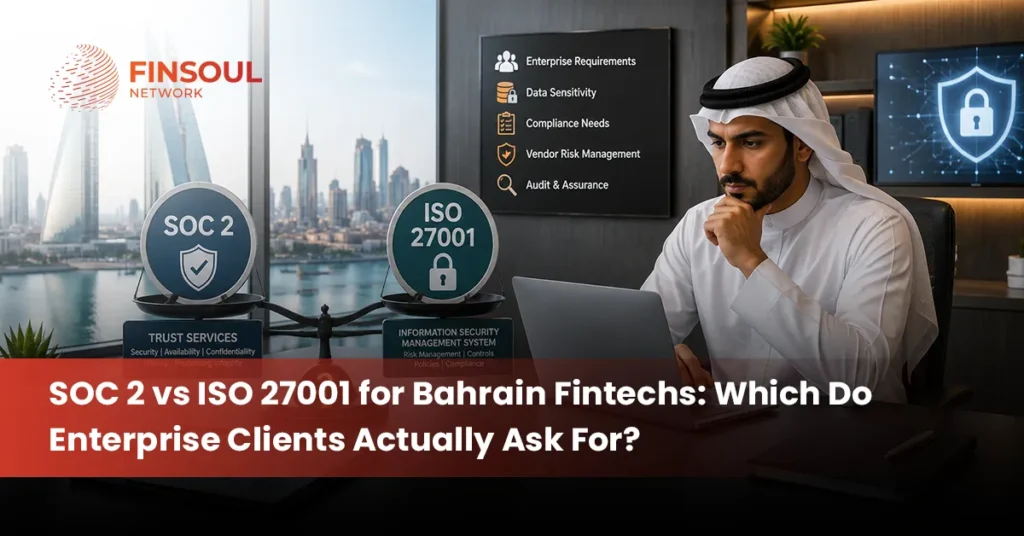
SOC 2 vs ISO 27001 for Bahrain Fintechs: Which Do Enterprise Clients Actually Ask For?

  For a Bahrain fintech selling technology to banks, financial institutions or large enterprises, strong cybersecurity controls are only part of the challenge. Enterprise buyers increasingly want independent evidence that those controls exist and operate as expected. This is where SOC 2 compliance Bahrain and ISO 27001 certification Bahrain become relevant. The two are often presented as competing security credentials, but they provide different forms of assurance. ISO/IEC 27001 is an international standard used to certify an Information Security Management System (ISMS), while SOC 2 is an attestation examination that reports on controls relevant to security and other selected Trust Services Criteria. For fintechs in 2026, the better question is not simply whether SOC 2 or ISO 27001 is stronger. It is which assurance format the enterprise clients you want to win actually expect. SOC 2 vs ISO 27001: What Is the Main Difference? ISO 27001 certifies an organisation’s information security management system, while SOC 2 provides an independent attestation report about controls within a defined service organisation and system. ISO/IEC 27001:2022 remains the current requirements standard for an ISMS, alongside Amendment 1:2024. It takes a risk-based approach to information security and requires organisations to establish, maintain and continually improve a structured management system. SOC 2 is based on the American Institute of Certified Public Accountants’ Trust Services Criteria. A SOC 2 examination always addresses security and may also include availability, processing integrity, confidentiality or privacy depending on the scope. Area SOC 2 ISO 27001 Assurance type Attestation report Management-system certification Framework owner AICPA ISO and IEC Main focus Controls relevant to a defined system/service Information Security Management System Output SOC 2 report ISO/IEC 27001 certificate Geographic recognition Particularly common in US enterprise and SaaS procurement Broad international recognition Operating effectiveness Type II examines controls over a period Assessed through certification and surveillance Detailed client report Yes, for authorised users Certificate itself provides less control-testing detail Best fit Detailed customer/vendor assurance Organisation-wide security governance The distinction matters because an enterprise procurement team may accept one credential for one purpose while specifically requesting the other for another. What Does SOC 2 Compliance Mean for a Bahrain Fintech? SOC 2 compliance Bahrain refers to a fintech having relevant controls independently examined against applicable AICPA Trust Services Criteria. Security is central to a SOC 2 examination. Additional criteria can be included according to the service and customer requirements. These may address: Availability: Whether systems are available for operation and use as committed Processing integrity: Whether system processing is complete, valid, accurate, timely and authorised Confidentiality: Whether information designated as confidential is appropriately protected Privacy: Whether personal information is managed according to applicable privacy criteria This model can be particularly relevant to fintechs offering SaaS platforms, APIs, payment technology, transaction processing or other services where an enterprise customer depends directly on the provider’s systems and controls. SOC 2 Type I vs Type II A Type I report evaluates the design of controls at a specified point in time. It can show that an organisation has established an appropriate control environment. A Type II report goes further by examining whether relevant controls operated effectively over a defined period. For enterprise vendor-risk teams, Type II can therefore carry greater practical value. The buyer receives evidence not only that controls were designed, but that their operation was independently tested across the reporting period. SOC 2 Certification Is Not Technically a Certification The keyword SOC 2 certification Bahrain is commonly searched, but the terminology is technically incorrect. Organisations do not receive a SOC 2 certificate in the same way that they receive ISO 27001 certification. A qualified CPA practitioner performs the SOC 2 examination and issues an attestation report. This distinction becomes important when dealing with sophisticated financial institutions. A procurement team asking for a “SOC 2” may actually expect a current SOC 2 Type II report, including a defined system scope and reporting period. A Bahrain fintech should therefore clarify exactly what evidence a potential client requires rather than treating every request for “SOC 2 certification” as identical. What Does ISO 27001 Certification Mean for Bahrain Fintechs? ISO 27001 certification demonstrates that an organisation has established an Information Security Management System conforming to ISO/IEC 27001 requirements within the certified scope. ISO/IEC 27001:2022 uses a risk-based management approach. Rather than prescribing the same security configuration for every organisation, it requires the business to understand its information-security risks, determine appropriate treatment and maintain evidence that the ISMS operates and improves. This includes areas such as: Information-security risk assessment and treatment Leadership and security responsibilities Security policies and objectives Access and identity management Supplier and third-party security Incident management Business continuity considerations Monitoring and performance evaluation Internal audit and management review Corrective action and continual improvement For Bahrain fintechs planning to operate across multiple GCC or international markets, this internationally standardised management-system approach can provide a portable security foundation. Which Do Enterprise Clients Actually Ask For? There is no universal rule that Bahrain enterprise clients require ISO 27001 while international clients require SOC 2. Procurement requirements depend on the buyer, jurisdiction, service risk, data involved and internal third-party-risk programme. However, the commercial patterns are different enough to guide a fintech’s assurance strategy. Client or sales situation Assurance likely to be useful Bahrain or GCC enterprise ISO 27001 commonly provides recognisable international assurance Regional bank or financial institution ISO 27001 plus evidence against applicable regulatory requirements US enterprise customer SOC 2 Type II may be specifically requested International SaaS procurement SOC 2 can be particularly valuable Multinational enterprise ISO 27001, SOC 2 or both depending on procurement policy High-risk technology supplier Both may form part of a wider assurance package CBB-regulated activity Applicable CBB requirements must be addressed separately The table should not be read as a regulatory requirement. It is a decision framework for understanding why different enterprise buyers can request different evidence. Why ISO 27001 Often Makes Sense for Bahrain and GCC Clients ISO 27001 has broad international recognition and is not tied to one country’s enterprise assurance

Bahrain Halal Platform
Blog

The Bahrain Halal Platform: What the New Online Verification System Means for Certified Producers

Bahrain has moved its halal certification process online, and the change is bigger than a simple system upgrade. The Bahrain Halal Platform now sits at the center of how producers apply for, track, and renew their halal status in the kingdom. For any business that manufactures, imports, or exports halal food and beverage products, understanding this platform is no longer optional. Finsoul Network Bahrain works closely with producers to help them navigate this shift, and this guide breaks down exactly what the new system means, how it works, and what certified producers need to do next. What Is the Bahrain Halal Platform The Bahrain Halal Platform is the official digital system introduced to manage halal certification applications, approvals, and renewals across the kingdom. Instead of submitting paper documents and waiting weeks for manual review, producers now apply, upload documents, and track their certification status through one centralized online portal. The platform connects producers directly with certifying authorities, reducing the back and forth that used to slow down approvals. It also creates a single digital record that buyers, regulators, and trade partners can reference to confirm a product’s halal status at any time. Why Bahrain Launched a New Online Halal Verification System Bahrain’s food and beverage export sector has grown steadily, and the old paper-based certification process could not keep pace with demand. Producers faced long processing times, inconsistent documentation standards, and limited visibility into where their applications stood. The new online system was built to solve these exact problems. It standardizes how applications are submitted, shortens review cycles, and gives regulators better oversight of the entire certification pipeline. This move also aligns Bahrain with regional trends, as neighboring Gulf markets have already digitized the Halal certification Bahrain businesses depend on for cross-border trade. Before this shift, producers often waited months for a single renewal cycle to clear, with little insight into where a file sat inside the review chain. Manual handoffs between departments created bottlenecks that had nothing to do with the actual quality of a producer’s operation. Digitizing the process addresses the administrative delay directly, rather than asking producers to simply wait longer for the same manual system to catch up. How the Bahrain Halal Platform Verification Process Works The verification process on the platform follows a clear sequence, though the exact steps can vary slightly depending on the product category. Producers create an account and register their business details on the platform Product information, ingredient lists, and supplier documentation are uploaded digitally The system routes applications to the relevant certifying body for review Inspectors may schedule a facility audit before final approval Once approved, a digital certificate is issued and linked to the producer’s profile Renewal reminders and status updates are sent automatically through the portal This structure removes much of the guesswork producers used to face. Every stage of Bahrain Halal certification is now visible in real time, which means fewer surprises and fewer delays caused by missing paperwork. Producers who take time to understand this sequence before applying tend to move through review far more smoothly than those who submit incomplete files and correct them one round at a time. Knowing what an inspector looks for at each stage, from ingredient traceability to labeling accuracy, saves weeks of back and forth later. Bahrain Halal Certification Requirements for Producers Producers applying through the platform need to prepare a specific set of documents and information before starting the process. Requirements typically include a valid commercial registration, detailed ingredient and sourcing documentation, supplier halal certificates where applicable, and facility details for inspection scheduling. Requirement Purpose Commercial registration Confirms the business is legally licensed to operate in Bahrain Ingredient and sourcing list Verifies raw materials meet halal standards Supplier certificates Confirms upstream suppliers are also halal compliant Facility layout and process details Supports inspection and audit scheduling Product labeling samples Ensures labeling matches certification claims Getting these documents right the first time is one of the biggest factors in how quickly a Bahrain Halal certification application moves through review. Producers who assemble a complete file up front, including translated documents where needed, generally avoid the multiple review cycles that stretch out approval timelines for less prepared applicants. Benefits of the Bahrain Halal Platform for Certified Producers Moving certification online brings real, measurable advantages for producers who depend on halal status to access markets. Faster Processing Times Digital submissions and automated routing cut down the manual handling that used to slow approvals. Producers using the new system typically see shorter turnaround times compared to the old paper process. Greater Transparency Every application stage is tracked and visible to the producer. There is no more waiting on a phone call to find out if a document was received or reviewed. Stronger Market Access A verifiable digital certificate strengthens trust with international buyers and distributors, particularly in markets that increasingly expect digital proof of Halal certification Bahrain producers can present on demand. Easier Renewals Automated reminders and pre-filled renewal forms reduce the risk of certification lapsing, which protects continuous market access. For producers exporting on tight retail contracts, an expired certificate can halt shipments overnight, so this single feature carries more business weight than it might first appear. Who Benefits Most From the New System Certain businesses feel the impact of this shift more than others, largely because of how often they interact with the certification process. Food manufacturers exporting to Gulf and international markets Restaurant chains and catering companies seeking group certification Importers who need to verify halal status of incoming products Meat and poultry processors subject to routine facility audits Ingredient suppliers whose certificates feed into larger producer applications Small and medium producers with limited administrative staff Each of these groups relies on fast, predictable certification cycles to keep operations running, and the digital process gives all of them a clearer view of where they stand at any given time. Common Challenges Producers Face During the Transition Not every business finds the shift to digital certification straightforward. Common obstacles include:

ISO 27001 for insurance companies Bahrain
Blog

ISO 27001 for Bahrain Insurance Companies: What CBB Expects Beyond Banks and Fintechs

Cybersecurity discussions in Bahrain’s financial sector often focus on banks, payment companies and fintech platforms. That can leave insurance companies with the impression that cyber regulation sits further from their core business. It does not. Insurers hold identity documents, medical information, claims records, financial details, policy histories and payment data. They also depend on brokers, cloud services, claims platforms, external administrators, mobile applications and other third parties. A cyber incident can therefore interrupt claims handling while exposing information that is both commercially sensitive and personally identifiable. For companies assessing ISO 27001 for insurance companies Bahrain, Finsoul Network Bahrain provides a practical perspective on how an information security management system can demonstrate the governance, testing, monitoring, reporting and resilience that the Central Bank of Bahrain expects from insurance licensees. Insurance Companies Sit Inside the CBB Cybersecurity Framework CBB Volume 3 contains specific cyber-security risk-management requirements for insurance firms and insurance licensees offering products or services through digital channels. This is important because Bahrain’s insurance sector is not regulated as an afterthought to banking. The CBB regulates insurance service providers directly and applies a dedicated insurance Rulebook under Volume 3. CBB figures show 141 authorised insurance companies and organisations in Bahrain as of December 2025, including insurers, reinsurers, brokers, consultants and other market participants. The insurance cyber-security chapter begins with board-level responsibility rather than an IT checklist. That tells insurers something important about the regulator’s approach: cyber risk is an enterprise risk, not only a technical issue. The First CBB Expectation Is Board Ownership The board must ensure that the insurer has a robust cyber-security risk-management framework and must approve the cyber-security policy. CBB Rulebook Volume 3 requires clear ownership, decision-making and management accountability for cyber risks. The framework must include a cyber-security strategy, cyber-security policy, risk-management methodology and organisation-wide awareness programme. The board is also expected to receive cyber information at its meetings, including control-maturity reporting, security-awareness status, relevant incidents and penetration-testing results. That goes beyond approving an information-security policy once and leaving implementation to IT. Where ISO 27001 Fits   and Where It Does Not ISO/IEC 27001:2022 can provide the management-system architecture for controlling information-security risk, but CBB’s own regulatory framework remains the compliance benchmark. ISO 27001 requires an organisation to establish, implement, maintain and continually improve an information security management system, or ISMS. It uses a risk-based approach to preserve confidentiality, integrity and availability of information. The current published edition remains ISO/IEC 27001:2022, together with its 2024 climate-action amendment. CBB, however, expressly states that the insurance cyber-security risk-management framework must be developed in accordance with the NIST Cybersecurity Framework summarised in its own control guidelines. That creates an important compliance distinction: ISO/IEC 27001 CBB insurance cyber requirements International ISMS standard Regulatory requirements for CBB insurance licensees Risk-based management system NIST-based cyber-security framework Certification can be obtained Regulatory compliance is supervised by CBB Controls selected according to risk Several CBB controls and frequencies are explicitly prescribed Continual improvement model Includes regulator-specific reporting and testing requirements Why an ISO Certificate Is Not Enough for a CBB-Regulated Insurer A company can have a valid ISO 27001 certification Bahrain certificate and still have regulatory weaknesses. The reason is straightforward: ISO 27001 asks the organisation to operate an effective risk-based ISMS, while CBB adds detailed obligations specific to regulated financial institutions. For example, CBB specifies how cyber governance should be organised, how often certain penetration testing must occur, when cyber incidents must be reported and how the cyber-security function should be separated from IT. If those regulatory details are missing, the existence of an ISO certificate does not fill the gap. CBB Expects Cyber Risk to Be Independent From IT Insurance licensees must establish a cyber-security risk function that is independent of the IT department. The function must report to an independent risk-management function or equivalent and monitor the maturity and status of relevant cyber controls. The board must also ensure that this function is headed by a suitably qualified Chief Information Security Officer (CISO) with sufficient authority. This separation is significant. IT teams build and operate technology. Cyber-risk functions need to be capable of independently challenging whether that technology is adequately protected. A small insurer may therefore need to think carefully about reporting lines even if the same people have historically handled both IT operations and information-security oversight. Every Insurance Board Meeting Should Have Cyber Visibility CBB expects cyber security to remain visible at board or board-committee level rather than appearing only after an incident. The Rulebook identifies information that should reach the board, including: Cyber KRIs and KPIs: Indicators showing whether exposure or control performance is changing Control maturity: Evidence of how effectively cyber-security controls are operating Awareness status: Visibility over employee information-security awareness Incident intelligence: Updates on internal incidents and relevant external threats Penetration-test results: Findings from testing the insurer’s defensive controls CBB Testing Requirements Go Beyond an Annual ISO Audit Insurance licensees must perform penetration testing at least twice each year. The CBB requirement applies to systems, applications and network devices. Testing must simulate real-world attacks and use a recognised risk-based methodology such as NIST or OWASP. CBB also specifies independence requirements for testing resources. This is a useful example of why insurers should not treat an ISO surveillance audit as their regulatory cyber-testing programme. An ISO certification audit evaluates conformity of the management system. It is not a replacement for technical penetration testing. Vulnerability Management Has to Be Continuous CBB’s approach also expects insurers to look for weaknesses before attackers find them. The Rulebook requires regular technical vulnerability assessments covering internal technology, external technology and connections with third parties. It notes a preference for approximately monthly internal assessments and weekly or more frequent checks of external public-facing systems. The insurer must also operate vulnerability and patch-management processes so identified weaknesses are addressed according to their level of risk. For an ISO 27001 insurance sector programme, this means vulnerability management cannot exist only as an Annex A policy. Evidence needs to show that detection, prioritisation, remediation and escalation occur

NHRA medical device registration Bahrain
Blog

New Bahrain Medical Device Rules 2026: ISO 13485 Certificate Now Required for Registration

Bahrain’s healthcare regulator has tightened the rulebook, and manufacturers, importers, and distributors are scrambling to catch up. As of 2026, NHRA medical device registration Bahrain is no longer a simple paperwork exercise; it now hinges on holding a valid Quality Management System certificate before an application is even accepted.  At Finsoul Network Bahrain, we’ve spent the past year guiding companies through this exact shift, and this guide breaks down everything you need to know about the new rules, the full registration process, the documents you’ll be asked for, and how to avoid the delays that are catching so many applicants off guard. What Is NHRA Medical Device Registration Bahrain? The National Health Regulatory Authority (NHRA) is the government body responsible for approving every medical device sold, imported, or used within the Kingdom. NHRA medical device registration Bahrain confirms that a device meets safety, performance, and quality benchmarks before it ever reaches a hospital, clinic, or pharmacy shelf. Since the mandatory registration deadline of February 1, 2026, no unregistered device can legally enter the Bahraini market, and enforcement checks at customs and during tender participation have become noticeably stricter across nearly every device class. Registration also serves a transparency function: once approved, the device and its Authorized Representative appear on the NHRA website, which institutions use to confirm a supplier is legitimate before purchasing. Why ISO 13485 Certification Bahrain Is Now Mandatory Under the updated 2026 framework, submitting an application without a recognized Quality Management System certificate is no longer accepted, even as a temporary workaround. This certification is now treated as a core prerequisite for physical manufacturers seeking approval, alongside CE marking or FDA clearance where those apply. This shift aligns Bahrain more closely with GCC and EU standards, moving the system away from paper declarations and toward documented, auditable proof of consistent manufacturing quality, structured risk management, and functioning post-market surveillance. Regulators across the region, including Saudi Arabia’s SFDA and the UAE’s MoHAP, have made similar moves in recent years, so Bahrain’s tightening is part of a broader Gulf-wide trend rather than an isolated policy change. Overview of the New Bahrain Medical Device Rules 2026 The updated regulation reshapes several parts of the registration journey at once: Mandatory registration for all medium- and high-risk devices (Class IIa, IIb, III, and IVD Class B, C, D), with Class I registration still recommended even though it remains technically optional A recognized quality certificate is now required at the point of submission, not simply recommended as supporting evidence Applications move through the Ajheza electronic system, which has largely replaced older manual, appointment-based submissions Stricter risk-classification checks are applied before an application is even accepted for review Ongoing post-market vigilance obligations continue well after approval, not just at the registration stage Taken together, these changes mean that NHRA medical device registration Bahrain now moves in lockstep with certification readiness, rather than as two separate tracks handled at different times. ISO 13485 Requirements Bahrain: What You Need to Prepare Meeting ISO 13485 requirements Bahrain means demonstrating that your quality system covers the full product lifecycle, not just the manufacturing floor. NHRA reviewers typically expect to see: A valid Quality Management System (QMS) certificate issued by a recognized, accredited certifying body Documented design control, risk management, and supplier qualification procedures Evidence of scheduled internal audits and a functioning corrective-action process A traceability system for distribution monitoring, often maintained through dedicated software or a structured spreadsheet Certificate validity of at least one year at the time of submission, with the manufacturer’s address matching the technical file exactly Devices falling under Class I non-sterile categories, or general IVDs, may sometimes submit a Declaration of Conformity instead of a full certificate. For most medium and high-risk devices, however, the certificate remains non-negotiable, and mismatched addresses or expired validity periods are among the most common reasons applications for NHRA medical device registration Bahrain get sent back. Step-by-Step Process for NHRA Medical Device Registration Bahrain Appoint an Authorized Representative (AR). Only a Bahrain-registered AR is legally permitted to submit an application, and this step should happen before anything else. Determine the device classification as Class I, IIa, IIb, or III in accordance with NHRA’s risk classification guidelines, as the required documentation varies depending on the device’s risk level. Compile technical documentation, including user manuals, service manuals, labeling artwork, and detailed product descriptions. Attach your quality certificate. This is where ISO 13485 certification for medical devices becomes essential, alongside CE or FDA evidence if your device already holds it. Submit through Ajheza and, where required, book an appointment for document review or in-person verification. Await NHRA review, which typically takes six to eight weeks, with up to two opportunities to correct deficiencies before a resubmission fee applies. Receive approval and public listing on the NHRA registry, after which the device can legally be imported, distributed, and marketed across the Kingdom. Device Classification and Fees Bahrain classifies medical devices according to their level of risk, following a system broadly aligned with EU standards. The classification determines the level of regulatory scrutiny, documentation required, and applicable fees. Device Class Risk Level Examples Requirements & Fees Class I Low risk Bandages and similar basic devices Basic technical documentation; lower registration fees Class IIa / IIb Moderate risk Infusion pumps, imaging equipment More detailed technical documentation and greater scrutiny; moderate fees Class III High risk Implantable devices Extensive technical documentation and close review of the manufacturer’s certificate; higher fees Fast Track Varies by device class Eligible devices assessed through approved conformity assessment bodies Faster processing; fees vary according to device class and the Fast Track pathway Who Needs to Prioritize Registration Right Now Not every company faces the same urgency, but several groups should move quickly: Foreign manufacturers entering the Bahraini market for the first time Importers and distributors handling Class IIa, IIb, or III devices Companies whose existing quality certificates are close to expiry Businesses still relying on outdated manual submission methods instead of Ajheza For all of these groups, NHRA medical device

ISO 9001 for manufacturing companies
Blog

ISO 9001 for Bahrain Manufacturing Exporters: Quality Requirements for GCC Market Access

Bahrain’s manufacturing sector is expanding rapidly as exporters look to strengthen their footprint across the Gulf Cooperation Council region. For companies aiming to compete on price, quality, and reliability, ISO 9001 for manufacturing companies has become the baseline expectation rather than an optional extra. At Finsoul Network Bahrain, we work with local exporters who need practical guidance on turning quality management from a paperwork exercise into a genuine competitive advantage. This guide breaks down every subtopic a Bahrain-based manufacturer needs to understand before pursuing certification. What Is ISO 9001 for Manufacturing Companies? ISO 9001 is the internationally recognized standard for quality management systems (QMS). It defines the criteria a manufacturer must meet to consistently produce goods that satisfy customer and regulatory requirements. For any exporter, ISO 9001 for manufacturing companies is not just a certificate on the wall; it is a documented system covering process control, risk management, supplier evaluation, and continual improvement. Buyers across the GCC increasingly ask for proof of this system before signing supply contracts, which makes the standard a practical market-access tool rather than a bureaucratic checkbox. Why GCC Market Access Depends on ISO 9001 Certification Bahrain The GCC Standardization Organization (GSO) and national bodies such as Bahrain’s Ministry of Industry and Commerce reference internationally recognized quality frameworks when evaluating imported and locally manufactured goods. Without ISO 9001 certification Bahrain, manufacturers often struggle to clear tender pre-qualification stages in Saudi Arabia, the UAE, Qatar, Kuwait, and Oman. Large GCC buyers, particularly in construction materials, food processing, and industrial equipment, use certification as a shortlisting filter. In practice, this factor often separates a shortlisted bidder from an excluded one. Core ISO 9001 Requirements Bahrain Manufacturers Must Meet Understanding the specific ISO 9001 requirements Bahrain exporters face is the first real step toward certification. The standard is built around several clauses that every factory must implement: Context of the organization: identifying internal and external issues affecting quality Leadership commitment: management must actively own the quality policy Planning: risk-based thinking and defined quality objectives Support: competent staff, calibrated equipment, and controlled documentation Operation: process control from raw material intake to finished goods dispatch Performance evaluation: internal audits, customer satisfaction tracking, and management review Improvement: corrective actions and continual system refinement These clauses apply regardless of factory size, but the depth of documentation typically scales with production complexity, which is why ISO 9001 requirements Bahrain manufacturers face can look different for a small workshop versus a large-scale exporter. Step-by-Step Certification Process for ISO 9001 for Manufacturers Bahrain Most Bahrain factories follow a similar path when pursuing ISO 9001 for manufacturers Bahrain certification: Gap analysis – comparing current practices against the standard’s requirements QMS documentation – writing quality manuals, procedures, and work instructions Staff training – ensuring employees understand their roles within the system Internal audit – testing the system before external review Management review – leadership formally evaluates system performance Certification audit – conducted in two stages by an accredited body Certificate issuance – valid for three years, subject to annual surveillance audits Each stage builds on the last, and skipping steps is the most common reason factories fail their first certification audit. Documentation and Quality Management System Essentials A functioning QMS needs more than a binder of policies. Manufacturers pursuing ISO 9001 for manufacturing companies status need traceable records: incoming material inspection logs, machine calibration records, non-conformance reports, and corrective action logs. Auditors specifically check whether documented procedures match what actually happens on the shop floor. Exporters that treat documentation as a living system updated after every audit finding tend to pass surveillance audits with far fewer non-conformities than those who treat it as a one-time project. Benefits of ISO 9001 for Manufacturing Companies in Bahrain Beyond opening doors to GCC buyers, certification delivers measurable operational gains for ISO 9001 for manufacturing companies: Reduced scrap and rework through standardized process control Fewer customer complaints thanks to consistent output quality Stronger supplier relationships from structured vendor evaluation Easier onboarding of new staff using documented work instructions Improved eligibility for government tenders and export incentive programs Many Bahrain manufacturers report that internal efficiency gains pay for the certification cost within the first year, independent of any new export contracts won. Common Challenges Bahrain Exporters Face During Certification Factories new to formal quality systems often underestimate three things: the time required to train staff on new procedures, the discipline needed to maintain records consistently, and the cultural shift from reactive problem-solving to proactive risk management. Smaller manufacturers pursuing ISO 9001 certification Bahrain sometimes attempt to copy generic templates without adapting them to their actual processes, which auditors flag quickly. Working with a consultant familiar with Bahrain’s regulatory environment and GCC buyer expectations significantly reduces the risk of failed audits. Cost and Timeline Considerations For Bahrain manufacturers, the cost and timeline of ISO 9001 certification depend mainly on company size, number of employees, operational complexity, and the maturity of the existing QMS. Key Factor What to Expect Timeline Small manufacturers: 4–6 months; larger operations: 9–12 months Consultancy & Training Costs for QMS implementation, staff training, and process development Internal Audits Required to verify the QMS before the certification audit Certification Fees Fees charged by the certification body based on audit scope and company size Ongoing Costs Annual surveillance audits and three-year recertification Main Cost Drivers Employees, sites, production complexity, and existing documentation Plan your ISO 9001 investment early to avoid unexpected costs and certification delays. Choosing the Right Certification Body for ISO 9001 for Manufacturers Bahrain Check Accreditation Manufacturers should confirm that the certification body is accredited by a recognized accreditation forum member. Unaccredited certificates may not be accepted during GCC tender pre-qualification. Consider Industry Experience Look for auditors with experience in Bahrain’s manufacturing sectors, including food processing, metal fabrication, plastics, and industrial equipment. Industry knowledge helps ensure the audit focuses on relevant processes rather than generic checklist items. Compare Audit and Support Services When comparing certification bodies, consider audit scheduling, turnaround times, auditor expertise, and post-certification support for surveillance audits. Work

ISO 13485 Bahrain medical devices
Blog

ISO 13485 and NHRA’s New UDI Traceability Rules: Changings for Bahrain Device Companies from July 2026

Bahrain’s National Health Regulatory Authority is rolling out new Unique Device Identification traceability rules starting July 2026, and medical device companies operating locally have a narrow window to adjust. These rules do not exist in isolation. They sit directly on top of the quality system requirements already built into ISO 13485 Bahrain medical devices manufacturers, and distributors are expected to hold. Finsoul Network Bahrain has been tracking this regulatory shift closely, and this article explains exactly what changes, when it takes effect, and what device companies need to do before the deadline arrives. What NHRA’s New UDI Traceability Rules Actually Change Unique Device Identification, or UDI, assigns a distinct code to every medical device so it can be tracked from manufacture through to the point of use. NHRA’s updated rules require device companies to record and report UDI data at each stage of distribution inside Bahrain, closing a gap that previously relied on manual, inconsistent tracking between manufacturers, distributors, and healthcare facilities. For companies already running a certified quality system, this is less disruptive than it sounds. The traceability logic NHRA is asking for maps closely onto the device history and risk records that ISO 13485 requirements Bahrain auditors already check during certification, which means the new rule is really an extension of existing obligations rather than a separate compliance track. Timeline: What Changes From July 2026 NHRA has phased the rollout rather than switching everything on at once. Device companies should track these milestones: Timeline Requirement July 2026 UDI reporting becomes mandatory for Class C and D devices entering the Bahrain market. October 2026 Distributors must confirm UDI data at each transfer point in the supply chain. January 2027 Full traceability reporting extends to Class A and B devices. Ongoing NHRA reserves the right to audit UDI records during routine facility inspections. Companies already certified under ISO 13485 Bahrain medical devices procedures generally have less catching up to do at each milestone, since the device history record and traceability clauses already required by the standard cover much of what NHRA is now asking for in a formal reporting format. How This Connects to ISO 13485 Certification Bahrain Companies Already Hold ISO 13485 is the international standard for medical device quality management systems. ISO 13485 certification Bahrain device makers and distributors pursue covers design control, risk management, supplier evaluation, and post-market surveillance, alongside the record-keeping NHRA now wants tied to UDI data specifically. ISO 13485 is the international standard for medical device quality management systems. ISO 13485 Bahrain medical devices certification covers design control, risk management, supplier evaluation, and post-market surveillance, alongside the record-keeping NHRA now wants tied to UDI data specifically. ISO 13485 Requirements Bahrain Device Makers Must Meet Beyond the UDI question, ISO 13485 requirements Bahrain regulators expect include a documented quality manual, defined management responsibility, controlled design and development processes, and a corrective action system that closes the loop on complaints and non-conformities. Device companies preparing for certification for the first time often underestimate the design control clauses. These require evidence that risk was assessed at every stage of product development, not only right before launch, which is exactly the kind of record NHRA inspectors will want to see referenced during a UDI audit. Building UDI Traceability Into an Existing Quality Management System The practical fix is to treat UDI reporting as an extension of the device history record most certified companies already maintain under ISO 13485 Bahrain medical devices clauses on identification and traceability. Most companies need to work through a short list of tasks rather than build anything from scratch: Map UDI codes to existing batch and lot records Assign a system owner responsible for NHRA reporting Update supplier agreements to require UDI data at handover Test the reporting format against NHRA’s submission portal before July 2026 Brief the quality team, so UDI questions during a certification audit don’t catch anyone off guard Who Actually Falls Under These Rules The new requirements are not limited to large multinational device makers with a Bahrain office. Local distributors importing Class C and D devices, contract manufacturers producing under a Bahrain-registered label, and even smaller clinics that repackage or relabel devices before resale all fall inside the scope in practice. Companies that assumed UDI reporting was a manufacturer-only concern are often surprised to learn that distributors carry reporting obligations too. Anyone in the supply chain who holds ISO 13485 Bahrain medical devices certification already has a system built to capture this kind of data, which makes the transition considerably smoother than for companies starting from a blank slate. Risks of Missing the July 2026 Deadline Companies that miss the deadline risk more than a compliance notice. NHRA can restrict market access for non-compliant device categories, and distributors may refuse to carry products without verified UDI data attached to the shipment. For companies without valid medical device certification Bahrain authorities recognise, the UDI rules add a second layer of exposure on top of an already incomplete compliance picture, since neither the quality system nor the traceability data would meet the bar on their own. How Bahrain Device Companies Should Prepare Preparing early can help companies identify gaps in their quality systems, UDI data, and reporting processes before the July 2026 rollout. Companies preparing for ISO 13485 certification: Integrate UDI readiness into the same certification project rather than treating them as separate initiatives. Traceability procedures reviewed during certification can overlap with the information NHRA inspectors may request later. Companies already holding recognised certification: Focus primarily on the data and reporting gap. Existing quality procedures may already be in place and can be connected to NHRA’s required submission format. Conduct an internal readiness review: Review current procedures against the July 2026 milestones to identify missing UDI data, responsibilities, documentation, and reporting processes. Start certification early: Companies planning to pursue ISO 13485 certification should avoid waiting until the regulatory deadline approaches. Starting early can provide more time for documentation, implementation, and audit scheduling. Companies without existing certification: Allow additional time to

ISO 45001 for Bahrain Oil & Gas Contractors
Blog

ISO 45001 for Bahrain Oil & Gas Contractors: Bapco and EWA Vendor Safety Prequalification

Winning a vendor contract with Bapco or the Electricity and Water Authority (EWA) is no longer just about price or delivery speed. Both buyers have tightened their vendor prequalification rules, and safety documentation now sits near the top of the checklist. Contractors without a certified occupational health and safety system are getting filtered out before the technical evaluation even begins.  This is why ISO 45001 for oil and gas contractors has become a near non-negotiable credential for firms bidding on Bahrain’s energy sector work. Finsoul Network Bahrain has guided contractors across the sector through this exact prequalification process, and this guide breaks down what Bapco and EWA actually check, and how to get certified without losing months to paperwork. Why Bapco and EWA Are Raising the Safety Bar Bahrain’s two largest energy and utility buyers have both revised their contractor onboarding frameworks in recent years. Both now request proof of a working OH&S management system Bahrain auditors have actually verified, not just an internal policy document sitting in a drawer somewhere. The shift reflects a wider regional pattern. Rising insurance costs, stricter incident reporting rules, and pressure from international partners have pushed procurement teams to treat safety certification as a hard gate rather than a bonus. A contractor without ISO 45001 certification Bahrain assessors have signed off on is often removed from the shortlist automatically, regardless of technical strength. What ISO 45001 for Oil and Gas Contractors Actually Covers ISO 45001 is the international standard for occupational health and safety management systems. For contractors operating on refineries, pipelines, or utility sites, ISO 45001 for oil and gas contractors requires a documented system covering hazard identification, worker participation, incident investigation, and continual improvement. A safety manual alone no longer meets the bar. Unlike the older OHSAS 18001 certificates some contractors still hold, ISO 45001 places heavier weight on leadership accountability and worker consultation. This matters directly for Bahrain’s ISO 45001 Bahrain oil and gas contractor pool, since Bapco and EWA reviewers increasingly ask for proof that site supervisors, not only HSE managers, understand and apply the system day to day. Who Actually Needs This Certification Not every subcontractor on a Bapco or EWA site needs to hold the certificate directly, but the pool of companies that do is wider than most owners expect. Civil, mechanical, electrical, and instrumentation contractors bidding on maintenance, shutdown, or capital project work all fall inside the requirement in practice, even when the tender document does not spell it out explicitly. Smaller subcontractors sometimes assume the requirement only applies to the main EPC contractor. That assumption tends to backfire during site mobilisation, when the primary contractor’s own safety plan requires every party on site, including sub-tier vendors, to demonstrate an equivalent OH&S management system Bahrain reviewers can trace back to a valid certificate. Building the ISO 45001 for oil and gas contractors framework early avoids being the one vendor holding up mobilisation while paperwork gets sorted out under deadline pressure. Choosing a Certification Body in Bahrain Not all certificates carry equal weight with Bapco and EWA procurement teams. Both buyers generally expect certification from a body accredited under a recognised international accreditation forum member, rather than a locally issued certificate with no accreditation trail behind it. Before committing to a certification body, contractors should confirm three things: the body’s accreditation status, its experience certifying oil, gas, or utility contractors specifically, and its typical audit turnaround time. A body unfamiliar with site-based hazards common to refinery or pipeline work tends to produce a slower, less useful audit than one with direct sector experience. Bapco vs EWA: What Each Buyer Checks During Prequalification Bapco and EWA don’t run identical checklists, but the overlap is large enough that most contractors can prepare for both with a single certification effort. The table below shows what each buyer typically asks for during vendor review. Requirement Bapco Vendors EWA Vendors Certified OH&S system ISO 45001 required for high-risk scopes ISO 45001 required for site-based contracts Audit evidence Certificate plus latest audit report Certificate plus incident log review Renewal check Annual vendor file review Contract-cycle review Worker training records Mandatory, updated yearly Mandatory, updated per project Getting Ready: Steps Toward ISO 45001 for Oil and Gas Contractors Certification Contractors preparing for ISO 45001 for oil and gas contractors certification who rush the process usually fail their first surveillance audit. A steadier path looks like this: Gap Assessment Compare current safety practices against the ISO 45001 clauses. This step usually surfaces the biggest documentation gaps early, before they cost time later in the process. Build the Management System Document hazard registers, risk assessments, emergency procedures, and defined roles. This becomes the backbone of the OH&S management system Bahrain assessors will test during the audit. Train Supervisors and Site Workers Bapco and EWA both check training records closely. Everyone from site supervisors to subcontracted labour needs to understand their role in the system, not just sign an attendance sheet. Run an Internal Audit An internal audit, followed by a management review, catches weak points before an external certification body does. This step separates contractors who pass first time from those who need repeat visits. Certification Audit with an Accredited Body The final step is a two-stage audit by an accredited certification body. Once passed, the certificate becomes the document Bapco and EWA procurement teams will ask to see first. Common Challenges Bahrain Contractors Run Into A few issues repeatedly block contractors from finishing their ISO 45001 for oil and gas contractors application on time: Safety documents exist but are not linked to actual site practice Subcontractor records are missing or incomplete Training records are outdated by the time of the audit Site supervisors cannot explain the system when auditors ask direct questions Companies apply for certification too close to a tender deadline Why ISO 45001 Bahrain Oil and Gas Certification Pays Off Beyond Prequalification Certification is not only a box to tick for Bapco or EWA. Contractors with a functioning OH&S management system Bahrain regulators

Scroll to Top